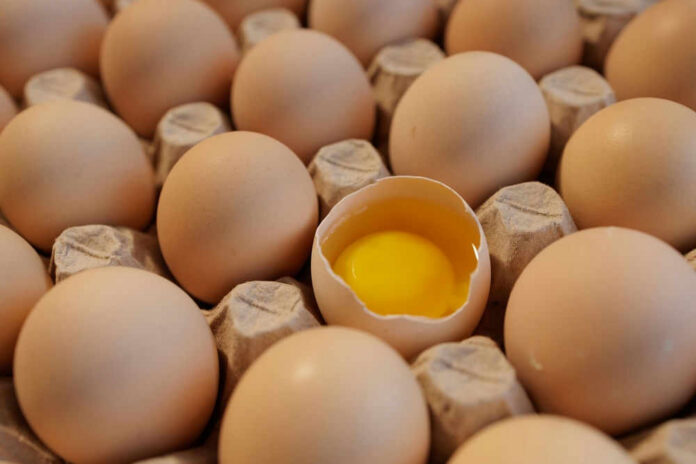
Nineteen million eggs vanished from store shelves in days, not because people were sick, but because one company’s routine tests hinted that trouble might be coming.
Story Snapshot
- Midwest Poultry Services voluntarily recalled 1,589,577 dozen eggs over possible salmonella contamination.
- Multiple brands and six states were swept into the recall, not just one farm label.
- No illnesses were linked to these specific eggs when the recall was announced, making it a preventive action.
- Environmental testing, carton codes, and farm traceability drove the decision to pull millions of eggs.
How a routine test triggered a massive egg recall
Midwest Poultry Services, based in Indiana, did not wait for people to land in the hospital before acting. The company says routine environmental monitoring at its Texas farms revealed a possible risk from Salmonella Enteritidis, a strain known to cause serious stomach illness.
That single signal set off a chain of decisions. Within days, the company voluntarily recalled 1,589,577 dozen white shell and brown cage-free shell eggs, which equals about nineteen million individual eggs. That is not a typo. One lab warning, millions of eggs gone.
The FDA and CDC have tied a growing Salmonella outbreak to eggs produced by Texas-based Midwest Poultry Services, which recalled roughly 1.5 million cartons – more than 19 million eggs – after the contamination surfaced. https://t.co/G9cACLMa6H
— CJ4America2 (@GrammyC4Zone2) July 26, 2026
The United States Food and Drug Administration said the eggs were produced at two Texas farms and then shipped across a wide region. The recall covered cartons sold in Texas, Oklahoma, Arkansas, Louisiana, New Mexico, and Mississippi, plus some smaller outlets beyond those states.
This was not one local grocer with a bad batch in the back cooler. It was a web of retail and food service buyers spread across the South, all suddenly told to stop selling specific eggs and to warn customers to check their fridges.
Brands, codes, and the confusing hunt in your refrigerator
Most people do not know which farm produced the eggs in their fridge. They recognize brand names. That is why this recall quickly felt big.
The affected eggs were packed under Kroger, Simple Truth, Brookshire’s, Country Morning, and Sunups brands, plus several bulk Grade A and Grade AA packs that never carry a consumer-facing farm name.
The recall cut across both budget and “cage free” marketing lanes, which means shoppers who thought they were buying safer, higher welfare eggs were suddenly told to throw them out.
Regulators and the company did not just tell people to panic. They gave exact markers so shoppers could sort safe from suspect cartons. Affected eggs carried plant codes P-1950 or 840962, with Julian dates between 157 and 184 stamped on the side of the carton.
Those numbers map to packing dates and farm locations. The recalled eggs were packed and distributed between June 6 and July 3, with sell-by or best-by dates between July 20 and August 17.
For anyone willing to squint at tiny ink on cardboard, it was possible to tell if the dozen you bought was part of the recall. The challenge, of course, is that most people never look at those codes unless something has already gone wrong.
Salmonella risk, real danger, and precaution
Salmonella Enteritidis is no small threat. Federal health officials say it can cause fever, diarrhea, and serious abdominal pain, and it is especially dangerous for kids, seniors, and people with weak immune systems.
In other egg-linked outbreaks, like the 2025 investigation into August Egg Company’s brown cage-free and organic eggs, 134 people were infected across ten states, with 38 hospitalizations and one death.
That earlier case showed what happens when contaminated eggs stay in circulation too long. Illnesses there started in February and ran into June.
In this Midwest Poultry Services case, reporters and regulators stressed one key fact: no illnesses had been tied to these recalled eggs at the time of the announcement. That means the recall was preventive.
Some skeptics online called it an overreaction. But if you value limited government paired with strong personal accountability, a voluntary recall before a disaster fits that framework: the firm bears the cost up front so the public does not bear it later.
What we still do not know about the exact contamination
The public record, at least so far, leaves key lab details offstage. News outlets and the recall notice say the issue was spotted through routine environmental testing at Texas facilities. That usually means swabs from equipment, barns, or packing lines tested positive for salmonella.
However, none of the coverage now available shows the exact sample, test method, or where the organism was found. We also do not see proof that eggs already on store shelves tested positive. The recall language stays at “possible contamination,” not “confirmed in product.”
Some people read that gap and assume the recall proves the eggs were dirty. Others assume the opposite, that the lack of confirmed sick patients means the recall was theater. Both views are too simple.
Food safety practice often demands removal of product whenever there is a plausible route from contamination to the consumer, even if the final step is not proven yet.
In the August Egg Company outbreak, regulators later matched the human cases to the eggs. Here, they are trying to avoid repeating that path. For now, the strongest documented facts are the company’s monitoring statement, the farm and brand list, the coded dates, and the zero reported illnesses.
Distraction, social media, and the next recall
This recall landed in people’s feeds as quick-hit warnings: “Check your fridge now,” “Nineteen million eggs recalled,” “Texas producer pulls product.”
Social media posts, television segments, and website alerts tended to repeat the brand names and the big number but left out the nuance about environmental monitoring and the lack of confirmed sick patients.
That style is great for grabbing attention, especially from rushed shoppers scrolling at the store. It is less helpful for anyone who wants to weigh the evidence and understand whether this was panic or prudence.
🚨: Another recall:
A major egg recall is underway after Midwest Poultry Services pulled approximately 1.6 million eggs over possible salmonella contamination.
The affected eggs were sold under brands including Kroger, Simple Truth, Brookshire’s, Country Morning and Sunups… pic.twitter.com/JJsbzwcLwx
— AmericaReal (@AmericaReal3) July 25, 2026
For readers who care about both freedom and responsibility, this story sits in a familiar tension. Companies that choose aggressive recalls protect consumers but also feed a public culture where any warning feels like proof of danger.
Yet the alternative is worse: waiting for kids and grandparents to get sick before acting. With eggs, a staple on almost every breakfast table, those stakes are too high.
The smartest takeaway is simple: know your carton codes, respect serious pathogens, and expect producers to act before the ambulance sirens start.
Sources:
foxbusiness.com, delish.com, today.com, youtube.com, fda.gov, poultrytimes.com