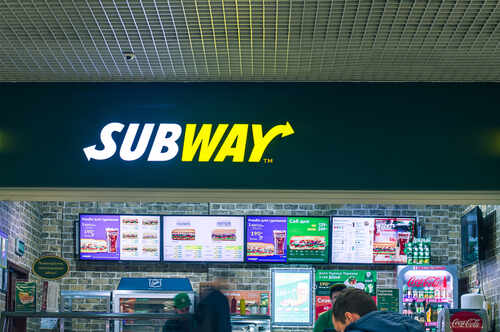
Subway just shuttered 729 American stores in a single year, marking the tenth consecutive year of decline for a franchise empire that once seemed unstoppable—and the real shocker isn’t just the closed doors, but what’s happening to the franchisees left holding the bag.
Story Snapshot
- Subway closed a net 729 U.S. locations in 2025, dropping below 19,000 stores for the first time in two decades after peaking at 27,000 in 2015
- Average store sales hover around $500,000 annually—roughly half what competitors generate—squeezing franchisees who bear all operational risks
- Corporate net income doubled to $688 million despite franchise revenue falling 6%, revealing a profit paradox where headquarters thrives while operators struggle
- The company calls it “rightsizing” with 800 temporary closures expected to reopen, though the decade-long contraction suggests deeper structural problems
When the Franchise Dream Became a Financial Nightmare
The franchise model that built Subway into a global behemoth is now strangling it. Subway’s 18,733 remaining U.S. franchisees face a brutal reality: their stores generate approximately $500,000 in annual sales while competitors command $800,000 or more.
That gap isn’t merely academic—it determines whether owners can cover rent, labor, and royalty payments while keeping enough to justify the risk. With inflation hammering food costs and wage floors rising, hundreds of franchisees simply walked away in 2025, closing shops that no longer penciled out financially.
Subway is continuing to shrink its U.S. footprint, closing a net 729 locations in 2025 — its steepest decline in years. https://t.co/BkK2cLi3WN
— KTVU (@KTVU) May 7, 2026
Subway corporate insists this represents strategic “rightsizing” toward optimal locations, pointing to approximately 800 temporarily shuttered stores they expect will reopen. Yet the numbers tell a harsher story. The company opened just 499 new locations in 2025—many of them reopenings—while the net loss hit 729.
That’s not pruning underperformers; that’s a structural hemorrhage that’s persisted for a full decade. Since 2016, Subway has contracted every single year, shedding roughly 8,000 U.S. locations from its 2015 peak of 27,000 stores.
Corporate Profits While Franchisees Lose Ground
Here’s where the story gets particularly galling for anyone who values fair dealing. Subway’s franchise revenue dropped 6% to $767 million in 2025, yet corporate net income surged to $688 million—nearly doubling. How does a company losing locations and collecting less in royalties simultaneously fatten its bottom line?
Cost-cutting and aggressive margin management, certainly, but this dynamic exposes the fundamental tension in franchise economics: corporate gets paid regardless of individual operator success.
Franchisees shoulder inventory costs, lease obligations, and employee payrolls while remitting royalties on every dollar of sales, whether profitable or not. When a store fails, the franchisee absorbs the loss; Subway corporate simply finds another optimistic entrepreneur to replace them.
This isn’t entrepreneurship—it’s a wealth transfer mechanism favoring the franchisor. The fact that Subway operates zero company-owned U.S. stores means headquarters has no skin in the game, insulating executives from the very market forces crushing their operators.
The Value Wars Nobody’s Winning
Subway recently launched a $5 value platform featuring 15 items, desperate to compete with McDonald’s budget meals and KFC’s promotional deals.
The sandwich chain’s response reveals how far it’s fallen behind. Where Subway once differentiated on freshness and customization, it now slugs it out on price alongside burger joints—a race to the bottom that erodes already-thin margins. Franchisees must absorb these value promotions while managing labor shortages and supply chain volatility, further compressing profitability at the unit level.
The competitive landscape shifted dramatically while Subway stood still. Chipotle and Panera captured health-conscious consumers with transparent sourcing and premium positioning. Fast-casual concepts offered ambiance beyond sterile sandwich assembly lines.
Even traditional competitors evolved—McDonald’s invested billions in restaurant modernization and digital ordering while Subway franchisees struggled to fund modest “Fresh Forward” remodels. When your average unit volume lags the industry by 40%, no amount of menu tinkering compensates for fundamental economic disadvantage.
What Rightsizing Really Means on Main Street
Subway’s closure of 729 locations translates to roughly 7,000 to 11,000 jobs lost, assuming 10 to 15 employees per store. These aren’t abstract statistics—they’re cashiers, sandwich artists, and shift managers who depended on steady paychecks.
Many shuttered locations sat in urban neighborhoods and lower-income areas where convenient, affordable food options are already scarce. When Subway corporate talks about “optimizing” locations, they’re abandoning markets that don’t meet profitability thresholds, leaving communities with fewer choices.
Subway closed over 700 US stores as franchise model faces strain https://t.co/brSHxwYTlQ
— FOX Business (@FoxBusiness) May 6, 2026
The company points to improving Google review scores and operational metrics as evidence their strategy is working. Carrie Walsh, Subway’s U.S. President, emphasizes focusing on “right locations” for long-term franchisee success. Fair enough—quality over quantity makes sense.
But ten consecutive years of contraction suggests this isn’t strategic refinement; it’s managed decline. Subway signed 93 new franchise agreements in early 2026 with expectations for roughly 100 new U.S. openings, a fraction of historical growth rates and barely enough to offset anticipated closures.
Global Success Cannot Mask Domestic Failure
Subway’s international expansion tells a different story. The company opened over 1,000 global locations in 2025 and holds commitments for 12,000 future stores worldwide. Emerging markets still view the brand as aspirational, and lower operating costs make the franchise economics work abroad.
This geographic arbitrage allows corporate to maintain overall growth narratives while the U.S. foundation crumbles. American franchisees subsidized Subway’s global brand building for decades; now they’re watching international markets capture the rewards.
The franchise model works splendidly when unit economics are sound and territories aren’t saturated. Subway violated both principles, flooding markets with underperforming stores through aggressive expansion in the 1990s and 2000s. The current contraction is the inevitable correction, painful and protracted.
Other chains faced similar reckonings—McDonald’s closed over 500 U.S. locations between 2020 and 2024; Starbucks executed global cutbacks in 2024. The quick-service restaurant industry is consolidating around stronger performers, and Subway’s decade of decline signals which category it occupies.
Sources:
Subway closed over 700 US stores as franchise model faces strain – Fox Business
Subway locations closures sandwich – The Independent
Subway closes over 700 restaurants in the United States what will happen to the chain – Merca20