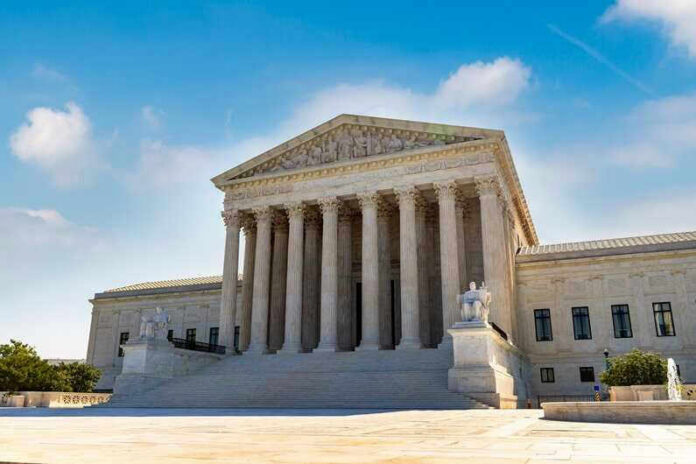
The Supreme Court just handed Alabama Republicans a last-second victory to reshape congressional districts, potentially flipping a Democrat seat days before primaries begin.
Story Snapshot
- U.S. Supreme Court issues 6-3 order on May 11, 2026, vacating lower court blocks on Alabama’s 2023 GOP map with one majority-Black district.
- Order remands cases for review under the April 2026 Louisiana v. Callais ruling, which limits Voting Rights Act claims on racial districting.
- Alabama reverts to the current two majority-Black district map used in 2024, targeting a 6-1 GOP delegation for the 2026 midterms.
- May 19 primaries proceed, but the results in affected districts may be voided under Gov. Kay Ivey’s special-election law.
- Liberal justices dissent, warning of voter confusion in this 11th-hour move.
Supreme Court Vacates Lower Court Rulings
The Supreme Court on May 11, 2026, granted Alabama’s emergency petitions in a 6-3 decision. Justices vacated three lower court rulings that enforced a map with two majority-Black districts.
The Court remanded the cases to district judges for reconsideration. This action cites the recent Louisiana v. Callais precedent, which requires proof of intentional racial discrimination in mapmaking. Alabama’s 2023 map, featuring one majority-Black district among seven, now stands as viable.
Timeline of Redistricting Battles in Alabama
Alabama enacted its initial post-2020 census map in 2021. The Supreme Court in June 2023 ruled 5-4 in Allen v. Milligan that it violated Voting Rights Act Section 2 by diluting Black votes, who comprise 27-28% of the population.
Lawmakers responded with a 2023 map packing Black voters into the 7th District. A district court rejected it in late 2024, imposing a two-district remedial map for the 2024 elections, yielding a 5-2 Republican majority.
April 2026’s Callais ruling reversed course, narrowing VRA protections by prohibiting race from dominating district lines in the absence of traditional districting rules.
Alabama seized the moment, passing a special election law and appealing to the Supreme Court. The May 11 order disrupts the status quo just before the May 19 primaries.
The U.S. Supreme Court has set the stage for Alabama to get rid of one of two largely Black congressional districts before this year’s midterm elections. https://t.co/ipnrU3l7k2
— The Seattle Times (@seattletimes) May 11, 2026
Key Stakeholders and Their Positions
Gov. Kay Ivey and GOP legislators control redistricting, pushing the 2023 map to secure six Republican seats. Attorney General Steve Marshall hailed the ruling as restoring elected officials’ map.
Black voters and plaintiffs from Milligan seek proportional representation through two opportunity districts. Voting rights groups like the ACLU and the NAACP decry the dilution of minority influence.
Conservative justices, led by the 6-3 majority, prioritize state sovereignty and race-neutral mapping, aligning with common sense limits on racial gerrymandering. Liberal dissenters, including Justice Sotomayor, labeled the timing inappropriate, predicting chaos for voters heading to the polls.
Supreme Court clears path for Alabama to redraw congressional maphttps://t.co/lZIAPeXo7i
— Flushing Tenants Alliance (@flushingtenant) May 12, 2026
Immediate Electoral Disruptions and GOP Gains
May 19 primary results in unchanged districts count, but affected ones are voided under Ivey’s law, paving the way for special elections. This setup favors Republicans, who held five seats under the current map.
Reverting enables a likely flip of the second Democrat seat, bolstering House GOP margins ahead of the 2026 midterms, where control hangs by a slim margin.
Lower courts now hurry to reassess amid ongoing primaries. Alabama officials prepare to enact the 2023 map swiftly, maximizing GOP chances.
Long-Term Precedent for National Redistricting
Callais extends beyond Alabama, signaling to Louisiana, Georgia, and other states that VRA challenges face steeper hurdles. Conservatives view this as curbing judicial overreach into race-based quotas, restoring traditional criteria like compactness and communities of interest. Liberals frame it as eroding protections post-Shelby County.
By the 2030 census, expect Republican-led states to aggressively draw race-neutral maps, shifting the House balance rightward. Facts support the conservative stance: elected legislatures, not courts, best reflect the voters’ will without racial engineering.
Sources:
Supreme Court clears the way for Alabama to redraw congressional map
Supreme Court clears path for Alabama to redraw congressional map
Supreme Court greenlights 11th-hour Alabama redistricting plan for 2026 election
Supreme Court allows Alabama GOP to erase Black House district