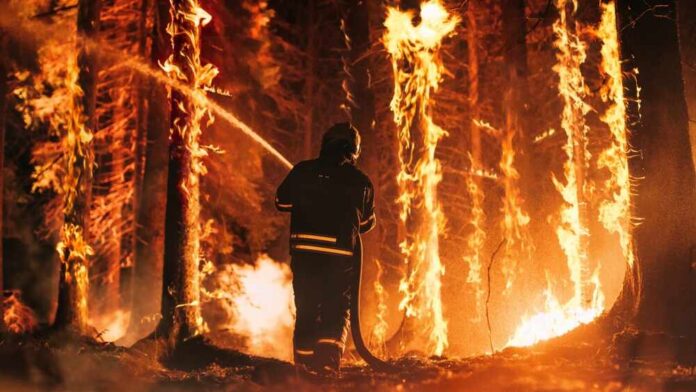
Wildfires around Spokane turned quiet suburbs into a disaster zone almost overnight, wiping out more than 600 structures and forcing tens of thousands of people to leave everything behind.
Story Snapshot
- Three fast-moving fires around Spokane destroyed at least 600 homes, businesses and other buildings.
- About 60,000 people in the Spokane area faced evacuation orders at the peak of the crisis.
- The Spokane Complex Fire burned roughly 7,700 acres in a single weekend, with zero containment early on.
- State leaders declared a wildfire emergency as Washington faced nearly 400 square miles burned statewide.
How A Normal Weekend Turned Into A Regional Fire Disaster
Residents in northwest Spokane started Saturday with normal weekend plans. By nightfall, entire neighborhoods were gone. Three separate blazes erupted in brush and grass near the city and quickly grew into what officials now call the Spokane Complex Fire.
Driven by strong winds and dry fuel, the Old Trails, Fairview and Autumn Lane fires tore through streets, jumped the Spokane River, and moved straight into populated areas. Families had minutes to grab kids, pets and car keys before walls of flame reached their blocks.
Authorities say these fires burned about 8.2 square miles, or roughly 21 square kilometers, in and around Spokane over the weekend. That may sound abstract, but on the ground it meant street after street of blackened foundations and chimneys standing alone in ash.
A federal incident management team later reported that the combined fire footprint reached about 7,708 acres with zero containment during the first phase of the response. Fire crews called the Spokane area the number one priority wildfire zone in the entire nation.
The Scale Of Loss: Structures Gone And People Displaced
Officials now estimate that more than 600 structures have been destroyed, including homes, businesses and outbuildings. Spokane County’s fire chief said one blaze, the Old Trails Fire, may have taken around 640 structures by itself.
These numbers are still early, and they include sheds, garages and other smaller buildings as well as full houses. Even so, the total means hundreds of families woke up to find everything they owned gone, from tools and tractors to baby photos and wedding dresses.
Over 600 buildings burned down and nearly 60,000 were ordered to evacuate after uncontained wildfires spread in the city of Spokane in Washington state, as Mayor Lisa Brown warned of possible loss of life https://t.co/UxMtVwckQ9 pic.twitter.com/FGWPiW38tv
— Reuters (@Reuters) August 3, 2026
At the same time, Washington faced something you rarely see outside war or hurricane zones: mass, city-scale evacuations. Authorities say about 5,000 homes were ordered evacuated around Spokane.
With an average household size, that figure lines up with social and media reports that roughly 60,000 people were told to leave the Spokane area for safety. Residents followed “go now” alerts as police and firefighters drove through neighborhoods, using loudspeakers and door knocks to clear streets ahead of the flames.
Why These Fires Exploded And Why Officials Are Alarmed
These fires did not happen in a vacuum. Washington had already logged more than a quarter-million acres burned statewide before Spokane’s weekend disaster. A separate report from state and local sources put the total closer to 390 square miles burned across the state, with many fires still not contained.
The National Weather Service took the rare step of issuing its highest-level fire weather alert, a “particularly dangerous situation” red flag warning for eastern Washington and parts of Oregon. Those alerts signaled that the mix of heat, wind and dry fuel made explosive fire growth not just possible, but likely.
Years of data from the Washington Department of Natural Resources show that eastern Washington has seen more frequent large fires, even in seasons when total burned forest acres stayed modest by historic standards. Dense grass, brush and dry timber now sit close to growing suburbs and highways.
When high winds arrive, embers leap across rivers, roads and even four-lane interstates. This is exactly what happened with the Old Trails Fire, which started in open land, then jumped barriers and rolled straight into Spokane neighborhoods.
Emergency Response, Relief, And The Questions Ahead
On the ground, firefighters from Washington, Idaho and federal agencies worked through the night to hold lines, defend homes and guide evacuees. Washington’s governor declared a statewide emergency and burn ban, which opened the door for federal disaster aid and National Guard support.
Crews cut fire breaks, dropped water and retardant from the air, and ran structure protection teams down suburban streets to save whatever they still could. By Sunday, incident command shifted from pure life-safety mode to a grim new task: counting what was lost and planning how communities can rebuild.
Wildfires in eastern Washington state forced the evacuation of 60,000 people in the Spokane area while destroying at least 600 homes, businesses and other structures, authorities said Sunday. pic.twitter.com/WNF2EgaIxE
— The Associated Press (@AP) August 3, 2026
For now, officials report no deaths and no missing-person cases tied to the Spokane fires, though they stress that the situation remains fluid and they are still checking destroyed areas carefully. That is a rare bright spot in an otherwise bleak story. The harder questions come next.
Local leaders must decide how to manage growth at the edge of fire-prone land, how to handle fuels near homes, and how to balance private property rights with the need to defend entire communities.
Sources:
washingtontimes.com, spokesman.com, clickondetroit.com, en.wikipedia.org, youtube.com, wasmoke.blogspot.com, dnr.wa.gov, wfca.com, nytimes.com, npr.org, abcnews.go.com