
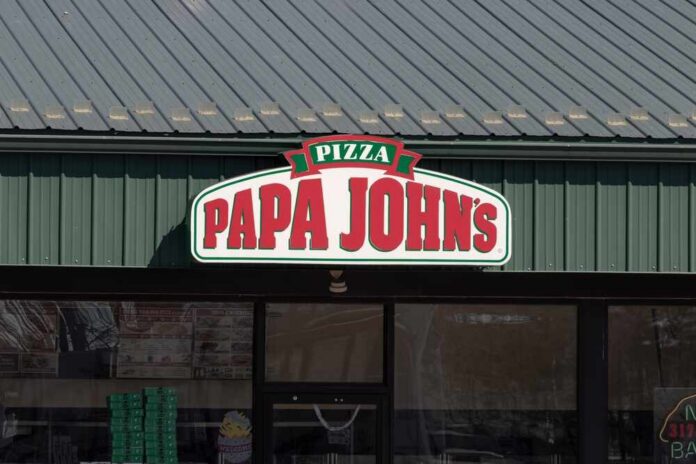
Papa John’s plan to shut roughly 300 underperforming locations is a fresh warning sign that higher costs and weaker demand are still squeezing everyday Americans—even as corporate leaders promise “surgical” fixes.
Story Snapshot
- Papa John’s says about 300 North American restaurants are slated to close, with roughly 200 expected in 2026.
- The targeted stores are mostly older, franchise-owned units with low annual sales and negative “four-wall” profitability.
- Management is pairing closures with a broader “asset-light” transformation, refranchising stores and cutting corporate overhead.
- The company still expects 40–50 gross North American openings in 2026, signaling a shift in footprint rather than a total retreat.
What Papa John’s Actually Announced—and the Timeline
Papa John’s told investors it expects to close about 300 underperforming restaurants across North America, one of the largest pullbacks the chain has announced in years.
Company leadership said roughly 200 of those closures are expected to occur during 2026, with most of the remainder completed by the end of 2027. What remains unclear from the available reporting is which specific cities or states will feel the impact most.
The announcement came as part of the company’s Q4 2025 earnings discussion in late February 2026, when executives also described a broader operational reset.
For many communities, the local impact is more immediate than corporate language: closures mean fewer nearby meal options, fewer entry-level jobs, and less foot traffic for adjacent small businesses. The public information available so far does not detail how employee transitions will be handled at each location.
Why These Locations Are Being Targeted
Papa John’s leadership described the closure list as focused on stores that do not have a clear path to sustainable improvement. Reported characteristics include restaurants that are primarily franchise-owned, more than a decade old, and producing average annual sales below $600,000.
The company also indicated many were generating negative “four-wall income,” a retail metric that reflects a store’s direct, location-level profitability before corporate overhead.
Papa John's planning to close hundreds of restaurants https://t.co/Ge1pMXylYr via @nwi
— Joseph S. Pete (@nwi_jsp) March 2, 2026
This is not a random downsizing; it is a quality-control decision aimed at raising systemwide performance by removing weak units. Executives described reviewing the quality of operations, the trade zone, and the physical asset itself to decide which locations should close.
From a practical standpoint, that means some communities will lose a familiar storefront while other markets—likely those with stronger demographics and better traffic—will be prioritized for investment and new builds.
Sales Pressure, Corporate Layoffs, and the “Asset-Light” Strategy
Papa John’s reported a same-store sales decline of 5% in North America in Q4 2025, a key data point explaining why the company is moving aggressively now. Alongside store closures, the company said it reduced its corporate workforce by 7% as part of a transformation plan to reduce costs.
Management also highlighted a shift toward becoming more “asset light,” which typically means fewer company-owned stores and greater reliance on franchise operators.
That refranchising push is already underway. The company has been working to reduce the share of company-owned restaurants in North America to the mid-single digits, including refranchising 85 units in November and negotiating additional refranchising in the Southeast.
For consumers, this strategy can be a mixed bag: strong local operators can improve service and consistency, but rapid ownership transitions can also create short-term turbulence in staffing, training, and execution.
What Closures Mean for Franchisees, Workers, and Local Communities
Most of the restaurants identified for closure are franchise-owned, which means the financial hit lands hardest on local operators who invested capital, hired workers, and signed leases.
Papa John’s has argued that closing chronically weak units can allow remaining franchisees to redirect resources to improve their core stores and pursue growth in stronger markets. The company also pointed to a prior rollout of this approach in the United Kingdom, where it said average unit volumes improved by 17%.
For workers, closures frequently mean a scramble—transfers to other stores if positions exist, or layoffs if they do not. For communities, the effect is straightforward: fewer paychecks circulating locally and another empty storefront at a time when many Americans have watched retail corridors hollow out.
The available reporting does not quantify projected job losses from the restaurant closures themselves, beyond noting the corporate workforce reduction.
A Broader Restaurant Trend, Not Just One Brand’s Problem
Papa John’s is not alone. Reporting around the announcement noted similar closure activity elsewhere in fast food, including Pizza Hut and Wendy’s, alongside signs of weaker same-store sales.
That pattern matters because it suggests the issue is not merely one company’s menu or marketing—it is a wider squeeze. When households pull back due to tight budgets, higher prices, and uncertainty, restaurants that depend on high volume quickly feel the pressure.
Papa John's to close hundreds of restaurants https://t.co/yeAg2CAby0
— Beloud (@beloudcom) March 3, 2026
Papa John’s says it still expects 40 to 50 gross restaurant openings in North America in 2026, which points to a rebalancing instead of surrender. The chain appears to be concentrating on higher-performing trade zones and newer units that can meet brand standards.
Until the company releases a market-by-market list, consumers and franchise owners are left with a familiar reality of corporate restructuring: the big picture may improve on spreadsheets, while local impacts arrive one closed door at a time.
Sources:
Papa John’s closing 300 restaurants
Papa John’s closing 300 restaurants, layoffs 7% of workforce