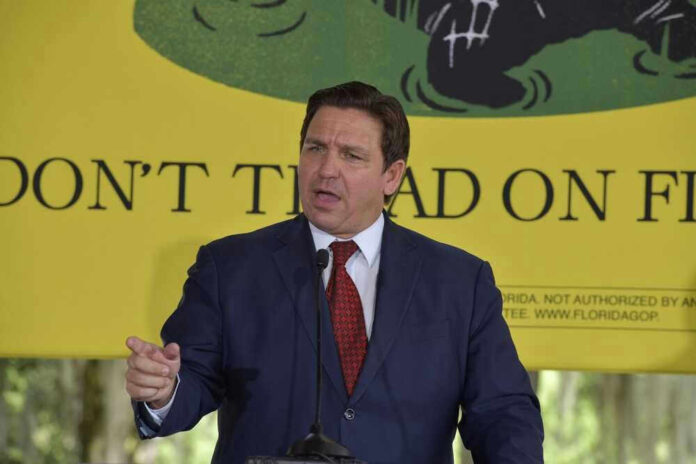
Leaving common-sense Americans shaking their heads, the Supreme Court has dealt a massive blow to Governor Ron DeSantis by refusing to let Florida enforce its tough new immigration law.
Millions are now wondering how upholding the Constitution suddenly means protecting chaos and handcuffing state leaders trying to defend their citizens.
At a Glance
- Supreme Court denies Florida’s emergency bid to enforce strict immigration law, keeping the measure on ice.
- The law, signed by Governor DeSantis, would have made it a crime for undocumented immigrants to enter or re-enter Florida and forced local law enforcement to cooperate with federal immigration authorities.
- Federal courts and advocacy groups argue the law conflicts with federal authority and could trigger racial profiling and discrimination.
- Florida officials vow to keep fighting, as the case heads back to lower courts, but for now, the state’s hands are tied.
Supreme Court Sides with Federal Power, Blocks Florida’s Law
Once again, the Supreme Court has stepped in to stop a state from doing the federal government’s job—because, apparently, the feds get first dibs on ignoring immigration laws. On July 9, 2025, the Court denied Florida’s emergency request to lift an injunction against SB 4-C, Governor DeSantis’s signature immigration crackdown.
The unsigned order offered no explanation, as if the constitutional lines between state and federal power are self-evident, at least when it comes to letting more people break the law without consequence.
Florida’s law, the toughest in state history, would have criminalized returning to Florida without legal status, ordered mandatory detention for certain immigrants, and required local governments to play ball with federal immigration authorities. Instead, the courts have told Florida to stand down while the legal wrangling continues.
Immigrant rights groups, predictably, cheered the ruling as a triumph for the Constitution and human rights, while the rest of us are left to wonder how upholding law and order turned into a constitutional violation.
The ACLU and similar organizations claim the law would encourage racial profiling and sow fear in immigrant communities. Meanwhile, Florida’s leadership—DeSantis and Attorney General James Uthmeier—slam the courts for taking away the state’s right to protect its own citizens.
The real winners? The federal bureaucracy and anyone who thinks the southern border should be a revolving door.
Judicial Pattern: States Blocked, Feds Fumble, Citizens Pay the Price
Florida is only the latest state to get smacked down for daring to act on illegal immigration. Courts have consistently ruled that immigration enforcement is the sole job of the federal government—even as that same federal government refuses to do it. The pattern is clear: Texas, Oklahoma, Idaho, and Iowa have all passed similar laws, only to have them blocked or struck down.
The Supreme Court’s inaction fits a well-worn trend of judicial skepticism toward any attempt by states to enforce the border. The result? A patchwork of toothless policies, endless lawsuits, and a federal government that can’t—or won’t—stem the tide.
For all the talk of “constitutional limits,” what’s really limited is the ability of states to protect their citizens from the fallout of Washington’s failures.
This legal limbo means Florida law enforcement must keep following federal guidelines, unable to use the new tools their own citizens’ representatives gave them. Local governments can’t enforce the law, and the message to illegal immigrants is loud and clear: you’re safe, for now.
Meanwhile, industries like agriculture and construction—always the first to cry labor shortage—watch nervously for what will happen if the law is ever allowed to take effect. For now, the only certainty is more uncertainty, more litigation, and more frustration for taxpaying citizens left footing the bill for a broken system.
The Real-World Impact: Safety, Sovereignty, and Common Sense on Hold
Let’s not sugarcoat what’s at stake. Since 2021, border encounters have skyrocketed, with over 140,000 in just the first month of FY2025. More than 650,000 criminal aliens roam free in the interior, according to ICE, and nearly two million “gotaways”—people who evaded capture entirely—are out there somewhere.
While the federal government dithers, communities are left dealing with the consequences: crime, strained services, and the erosion of the rule of law. Supporters of Florida’s law argue it is necessary to restore public safety and deter illegal entry. The opposition, well-funded and loud, says it’s discriminatory and unconstitutional.
But here’s the bottom line: when states are blocked from protecting their own borders, the people who suffer most are law-abiding citizens.
As the battle returns to the lower courts, the fate of state-level immigration enforcement hangs in the balance. If Florida loses, the precedent will embolden open-border advocates nationwide.
If it wins, other states may finally have a blueprint for defending their sovereignty and their communities. Until then, the courts have spoken—and common sense, as usual, is left on the sidelines.