
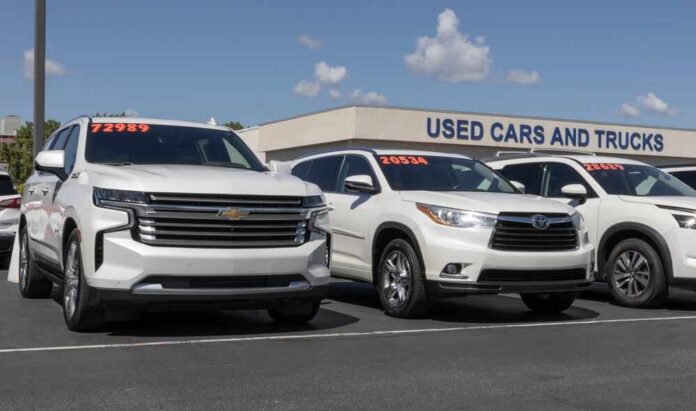
Used car prices are climbing back toward their 2023 highs, squeezing families who thought the post-pandemic sticker shock was finally fading.
Quick Take
- Major price trackers show used-car values rising again in early 2026, reversing the negotiating leverage buyers briefly had in 2024.
- Strong demand is colliding with still-tight supply, even as inventory shows modest year-over-year improvement.
- Tariff-driven pressure on new-car prices is pushing more shoppers into used vehicles, intensifying competition for affordable models.
- Segment data show the sharpest increases in luxury vehicles and pickups, while minivans are among the few categories declining.
Used-car values rebound as affordability erodes
U.S. used-car prices have returned to their highest level since summer 2023, according to multiple industry indices tracking listings and wholesale values. Data cited in the research point to year-over-year gains, with a used-vehicle value index reading of 213.4 and a 5.3% annual increase.
Even when month-to-month listing prices dip, year-over-year comparisons remain higher, leaving many buyers facing larger down payments and higher monthly payments.
February 2026 demand helps explain why prices are sticking. Used vehicle sales were reported at roughly 1.4 million units for the month, up 5.5% year over year, or about 50,400 vehicles per day.
At the same time, the average listing price reported in the research sits around $25,287—still elevated compared with last year. For households already worn down by inflation and high interest rates, a “cheaper than new” purchase can still feel financially punishing.
Used car prices rise to highest point since summer 2023 https://t.co/YgTrblRHSH
— CNBC (@CNBC) April 7, 2026
Why supply still feels tight even as inventory improves
The current surge differs from the 2021–2022 spike that was closely tied to semiconductor shortages and severe production constraints. Research summaries indicate inventory is up modestly year over year—about 1.6%—yet the market remains tight where typical buyers shop.
One reason is timing: fewer lease returns in prior years and owners holding onto vehicles longer reduced the flow of late-model used cars, and the recovery has been uneven.
Another complication is a mismatch in what’s returning to dealer lots. Research notes that an off-lease wave is arriving, but many of those vehicles are premium 2023-model-year cars that are simply priced beyond what mid-tier buyers can afford.
That means the supply that would normally relieve pressure on the “family budget” end of the market does not fully materialize. As a result, the practical supply of affordable, reliable used vehicles remains constrained.
Tariffs, new-car prices, and the spillover into used lots
New-car prices remain high in the research, with a cited average new vehicle transaction figure near $49,353. When policy and global trade decisions raise costs on imported vehicles and parts, manufacturers and dealers typically pass those costs along.
Whatever the politics behind tariffs, the mechanical impact for shoppers is straightforward: when new cars get more expensive, more consumers shift into used vehicles, and that demand spillover pushes used pricing higher.
Winners, losers, and the political frustration underneath it all
CARFAX segment data referenced in the research shows price increases are not evenly distributed. Luxury cars are up about $2,000 (8.0%), pickup trucks about $1,200 (3.7%), and hybrids/EVs about $600 (2.1%), while minivans are down roughly $300 (-1.6%).
Regional patterns matter too, with some of the biggest luxury increases reported in the West and Southwest. For many working families, these shifts translate into fewer “reasonable” options.
The bigger takeaway is how a basic necessity—reliable transportation—has become increasingly hard to secure at a fair price, even after the pandemic-era chaos was supposed to unwind. Conservatives often blame overspending, energy costs, and regulations that raise manufacturing and financing expenses; liberals point to inequality and market power in concentrated industries.
The data here doesn’t prove a single culprit, but it does reinforce a shared frustration: ordinary buyers have limited leverage while policy choices and market dynamics keep moving the goalposts.
Sources:
NerdWallet – Car Market Prices
CarEdge – 2026 Used Car Price Forecast
Kelley Blue Book – Is Now the Time to Buy, Sell, or Trade In a Used Car?