
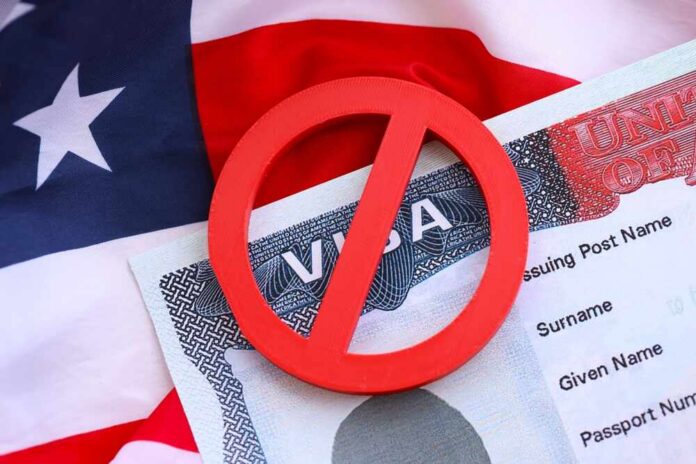
Washington is preparing the largest visa clean-up in U.S. history, and it targets people who used visitor visas, then claimed asylum.
Story Snapshot
- Officials outlined a rolling plan to revoke up to 200,000 business and tourist visas tied to asylum filings.
- The State Department already says it revoked more than 175,000 visas for violations and security risks.
- Federal law gives the Secretary of State broad power to revoke visas at any time.
- Courts just slapped down a separate, sweeping visa freeze, signaling judges will test broad actions.
What is actually planned and who gets hit
State Department documents described a plan to revoke B1 and B2 visas from foreigners who entered for short stays and then sought asylum, according to officials who spoke to the press. The action would move in waves rather than all at once, and the numbers may change as cases are reviewed.
The target population could reach 200,000. The focus is on people who used a visitor channel intended for tourism or short-term business, then switched to protection claims upon arrival.
Trump admin to target 200,000 foreigners in largest mass visa revocation ever: report https://t.co/rOXCrkHDg3 pic.twitter.com/xf8G8B5PSW
— New York Post (@nypost) August 25, 2026
The Department’s spokesman said revocations will be rolling, implying ongoing screening rather than a single purge. The plan follows a wider enforcement push.
Earlier this month, State announced more than 175,000 visas were revoked for violating terms, fraud, public calls for violence, crimes, and national security concerns.
That statement shows scale, systems, and intent already in motion. The new sweep narrows in on a pattern the government views as misuse of visitor visas to start an asylum process.
The legal backbone that makes this possible
Congress gave the executive branch clear tools. The Immigration and Nationality Act authorizes the Secretary of State to revoke a visa at any time, at his discretion. Consular officers also have authority to revoke when new facts show ineligibility.
Government auditors have long described how revocations begin and move through agencies, confirming that this is a standard enforcement lever, not a legal stunt. These powers exist so that officials can act quickly when later-discovered facts change a person’s eligibility.
Policy direction from the top sets the tone. Secretary of State Marco Rubio explained the test this way: if the government would not have issued the visa had it known certain facts, it should revoke it now. That is a plain standard most people grasp.
A visa is a conditional privilege tied to purpose. If you say you will visit and then use the trip to start a different legal track, you invite scrutiny of that original promise.
Fairness questions and how courts could shape the edges
Advocacy groups argue that mass actions risk error and weak notice. They claim that past student visa crackdowns relied on database hits and resulted in status terminations without due process.
Those claims have reached court and survived early motions, which keeps pressure on the government to show individualized review and proper notice.
A separate court just struck down an immigrant visa freeze that covered 75 countries, signaling skepticism toward blanket policies without tight tailoring.
BREAKING: Trump administration to revoke up to 200,000 B1/B2 visas of asylum seekers.
Targets visitors who “came as tourists but filed for asylum.”
Nigerians and other nationals could be affected.
Largest mass visa revocation in US history if implemented.#US #Nigeria #Visa— Negritude Edge (@IdumonzaI) August 25, 2026
Those challenges do not erase the State Department’s authority to revoke. They do push for process guardrails. The strongest path forward is precise case work: check the visa class, the timing of the asylum filing, and any overstay or fraud flags. Use human review over bulk automation.
Notify the person and document the record. That approach protects citizens from abuse of the system and protects legitimate visitors from sloppy errors.
Why the asylum pivot on visitor visas draws fire
Visitor visas exist for short trips. Asylum is a separate protection for people who fear persecution. Filing asylum after entry on a tourist or business visa does happen, and it can be lawful to claim protection.
The government’s case is that the pattern, at scale, signals misuse of the visitor channel, undermining trust in the system. The public release showing 175,000-plus recent revocations lends weight to the view that this is not a one-off gesture but part of sustained enforcement.
Two things will decide the public verdict. First, accuracy: are they targeting people who clearly flipped purpose, overstayed, or broke terms? Second, process: do they give clear notice and a path to challenge mistakes?
If the Department nails both, expect broad support. If not, judges will pare it back. The authority is solid in law; the execution will tell whether this becomes a course correction or a cautionary tale.
Sources:
redstate.com, thehill.com, usnews.com, theguardian.com, state.gov, myattorneyusa.com, congress.gov, community.lawschool.cornell.edu