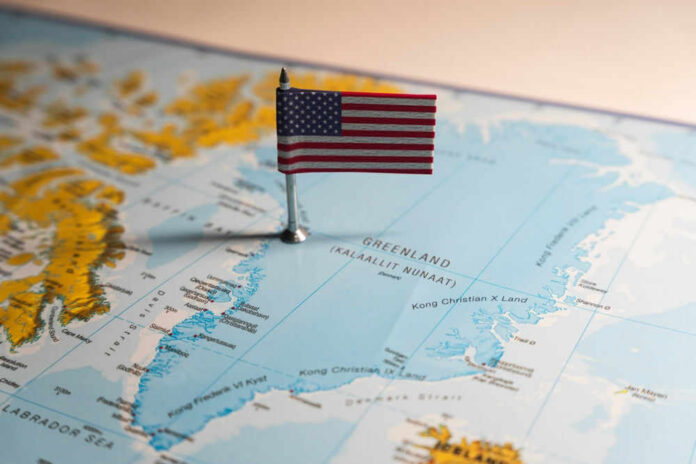
Washington, Copenhagen, and Nuuk just rewired Arctic security by greenlighting permanent U.S. access and new base rights in Greenland.
Story Snapshot
- The United States, Denmark, and Greenland announced a new security deal.
- The agreement grants U.S. permanent access, basing, and overflight rights, officials said.
- Denmark and Greenland said sovereignty remains intact under the pact.
- The parties aim to sign the deal during the United Nations General Assembly.
What Exactly Was Agreed And Why It Matters
The United States, Denmark, and Greenland said they reached a security agreement expanding U.S. military rights on the island. President Trump announced the deal and said the countries had entered into an agreement on Greenland’s security.
A U.S. State Department official said the pact gives U.S. forces permanent access, basing, and overflight rights in Greenland. This marks a major update to the long U.S. presence at Pituffik Space Base and the broader Arctic defense framework.
Danish and Greenlandic leaders backed the arrangement in public statements. They framed it as a security partnership that respects Greenland’s status within the Kingdom of Denmark. Denmark said sovereignty “would not be compromised,” and a joint message emphasized Greenland’s right to self-determination.
Taken together, these statements show a common goal: deter hostile powers in the Arctic while keeping political control with Copenhagen and Nuuk, not Washington.
US to open two Cold War-era military bases in Greenland as Trump celebrates landmark deal for 'permanent control' over security of territory https://t.co/wwAnOoEpsA
— Daily Mail (@DailyMail) September 22, 2026
What Changes On The Ground In Greenland
Officials described a bigger U.S. footprint with the legal room to build and operate more facilities. Reporting said the agreement bars non-North Atlantic Treaty Organization bases and screens “sensitive investments,” targeting risk from Russia and China without naming them in the public text.
A British outlet summarized an official claim that the United States can construct additional military structures without host-country approval, though the complete text has not been released publicly yet.
The plan also includes overflight rights that make Arctic air and missile defense more responsive. These air corridors matter for moving people, drones, fuel, and sensors across brutal distances and weather. The United States already runs missile warning and space tracking at Pituffik.
New authorizations can add runways, fuel farms, and radar sites to close gaps from the North Atlantic to the Canadian Arctic. Scale and timing will show up in force posture moves and construction contracts.
How This Fits A Long Arc Of Arctic Strategy
The deal builds on an old foundation. The United States has maintained bases in Greenland since World War II, supported by a 1951 defense agreement and later updates.
During the Cold War, the United States operated more than a dozen sites on the island. Over time, that network shrank, with Pituffik Space Base as the main holdover.
Today’s agreement renews that bond for a new era defined by long-range missiles, hypersonics, satellites, and sea lanes opening in summer ice.
US President Donald Trump is moving from his earlier ambition of acquiring Greenland to a security arrangement that would significantly expand the US military footprint on the Arctic island.
Here's what the deal is about 👇https://t.co/ru1c5Qc3CX
— Mint (@livemint) September 22, 2026
Allies see Greenland as a gate to North America and a shield for Europe. Early warning radars facing the polar routes buy minutes that can save cities. Undersea cables and space links also cross this theater.
From a national security lens, keeping adversary militaries and linked capital out of Greenland is common sense. It is cheaper than fighting later and smarter than waiting for an emergency to build the tools we need.
What Happens Next And The Practical Stakes
Leaders said they plan to sign the agreement at the United Nations General Assembly. After the signing, Danish and Greenlandic parliamentary steps will follow to bring it into force. This is normal for allied defense pacts and helps anchor public support.
As that moves ahead, watch for new Arctic spending lines, runway upgrades, fuel storage, and housing for rotational units. Those signals will show how fast the footprint grows and where it concentrates.
Federal planners will likely phase projects to protect the environment and respect Greenlandic communities. The cold drives costs up and punishes poor design. The reward is outsized: radar depth across the pole, better space tracking, and faster reach into the North Atlantic.
The announced ban on non-allied bases and tighter screening of sensitive investments will harden the island against strategic leverage from rivals, which is a direct win for the North Atlantic Treaty Organization.
Big Picture: A Small Island With Giant Leverage
This agreement converts geography into deterrence. It secures the seam where Europe meets North America and where sea, air, and space missions cross.
It also aligns three governments around a simple trade: the United States carries more of the security load; Denmark and Greenland keep their sovereignty affirmed. That is the Arctic version of peace through strength, and it is how free nations hold the high ground without firing a shot.
Sources:
nypost.com, nbcnews.com, aljazeera.com, npr.org, politico.com, reuters.com, euronews.com, goodmorningamerica.com