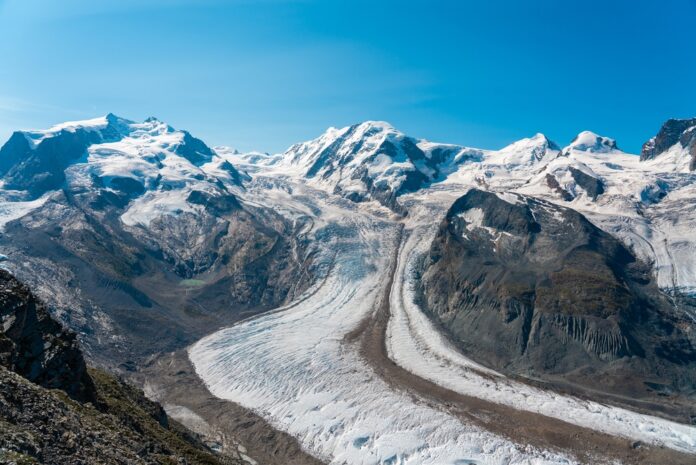
Colorado’s glaciers lost more ice in a single year than they typically lose in two, as record heat and almost no snow stripped away decades of frozen buildup in 2026.
Quick Take
- Andrews Glacier thinned more than 12 feet, Arapaho Glacier nearly 10 feet, and Isabelle Glacier about 6.5 feet during 2026, roughly double the average yearly loss of the prior five years.
- Colorado State University glaciologist Dan McGrath tracked the losses as part of ongoing glacier monitoring work.
- The 2026 water year was Colorado’s warmest on record, running 4.5 degrees above the 1991-2020 average.
- Statewide snowpack peaked at just 51% of average and vanished about a month earlier than normal.
Three Glaciers, One Brutal Year
Dan McGrath, a glaciologist at Colorado State University, measured the damage firsthand at three of the state’s best-known glaciers. Andrews Glacier near Rocky Mountain National Park thinned by more than 12 feet. Arapaho Glacier lost nearly 10 feet. Isabelle Glacier shed about 6.5 feet of ice. Those numbers came from fieldwork reported in late October 2026.
What makes these losses stand out is not just their size but their speed. Over the previous decade, these glaciers typically thinned by a foot or less each year. McGrath found the 2026 losses ran roughly double the average pace of the past five years, a dramatic jump that signals something unusual happened to the ice, not just a slightly rough season.
Glaciers survive on a simple balance. Winter snow has to pile up faster than summer sun melts it away. When that balance tips toward melting year after year, the ice sheet shrinks. Scientists who study glaciers nationwide, including teams at the United States Geological Survey, track this balance with snow depth readings, ablation stakes, and weather data gathered directly on the ice.
The Warmest, Driest Year Colorado Has Measured
The glacier losses did not happen in isolation. Colorado State University’s Colorado Climate Center reported that the 2026 water year, spanning October 2025 through September 2026, was the warmest ever recorded statewide. Temperatures ran 4.5 degrees Fahrenheit above the 1991-2020 average, topping the previous warm-year record by more than 2 degrees.
Snow told the same story. Colorado’s statewide snowpack peaked at only about 51% of average, and it hit that peak roughly a month earlier than usual. Early-season heat then tore through what little snow had fallen, melting it off the mountains far faster than normal.
Long-term snow records back up how extreme this year really was. Colorado tracks snow depth at 64 sites with at least 50 years of history. On April 1, 2026, a day researchers use as a benchmark, 60 of those 64 stations posted record-low snow water content. That kind of near-universal record, across six decades of data, leaves little room to call this a normal dry spell.
A Snowfield’s Disappearing Act Near Idaho Springs
Near Idaho Springs, the popular ice patch known as St. Mary’s Glacier told its own grim story. Snow researchers measured its basin snowpack peak at just 8.5 inches of water content, well below the normal 16.1 inches. By June 6, 2026, the snow was gone entirely, the first time that has happened in the site’s recorded history.
St. Mary’s carries the word “glacier” in its name, but scientists classify it as a semi-permanent snowfield rather than a true glacier like Andrews, Arapaho, or Isabelle. The distinction matters because a true glacier holds compacted ice that persists through the hottest summers, while a snowfield depends entirely on that year’s snow surviving the season.
Why One Bad Year Carries Weight
Glacier scientists generally caution that a single season rarely proves a long-term trend. What separates 2026 from ordinary variability is the pattern stacking up around it: record heat, a near-record-low snowpack, and measured ice loss all landing in the same twelve months. That convergence, documented through Colorado State University’s climate monitoring, turns a rough year into a flashing warning light for the state’s ice.
Coloradans who hike to Arapaho Glacier or ski past Andrews each summer have long treated these ice fields as fixtures of the high country, permanent backdrops to the Front Range. The 2026 numbers suggest that permanence is not guaranteed. Mountain ice built up over centuries can erode in a single scorching, snow-starved year, a reminder that the Rockies’ frozen landmarks are more fragile than their granite surroundings suggest.
Sources:
youtube.com, phys.org, chicagotribune.com, atmos.colostate.edu, aspentimes.com, denvergazette.com