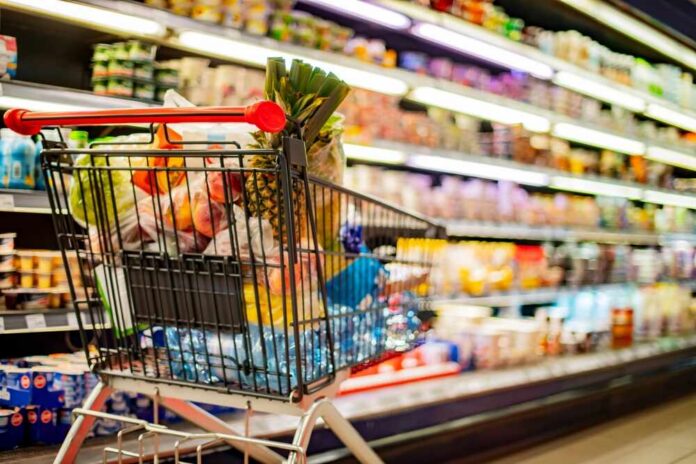
U.S. grocery shoppers are still buying food, but they are buying it differently, and that shift is squeezing food companies from both sides.
Quick Take
- Grocery sales rose 1.2 percent in 2025, but unit volume fell 1.0 percent as price increases lifted dollar totals.
- Several industry reports say shoppers are trading down, cutting impulse buys, and choosing private brands more often.
- Food-at-home prices are still rising, even if the month-to-month pace has cooled.
- There is a real tension in the data: spending totals remain large, but shoppers keep trimming basket size and unit counts.
Sales Are Up, But the Cart Is Lighter
The headline sounds simple: Americans are still spending on groceries, yet they are carrying home less. McKinsey says grocery sales increased 1.2 percent in 2025 while volume fell 1.0 percent, which means the market grew in dollars but not in units. That matters because food makers do not live on revenue alone. They live on how many boxes, bottles, and bags leave the shelf.
U.S. grocery slowdown deepens as shoppers buy fewer items, raising pressure on food companies https://t.co/F1jS89oACL
— CNBC (@CNBC) July 16, 2026
CoBank reaches the same basic conclusion from a different angle. It says consumers are trading down to cheaper food options, cutting discretionary purchases, and buying fewer groceries altogether.
Consumer Edge also says overall grocery spend declined roughly 3 percent year over year as shoppers rethink where they buy food. Taken together, those reports point to a market where price is doing more work than true demand.
Why Food Companies Feel the Pressure
This is why food companies are talking about strain instead of growth. If households pay more for each trip but buy fewer items, manufacturers can still see higher revenue on paper while losing volume underneath.
McKinsey says shoppers are shopping more often, trimming basket size, comparing prices, using promotions, and buying more private brands. That is not a healthy expansion story. It is a survival story dressed in a grocery bag.
Food Dive reports that manufacturers now warn of a prolonged downturn in spending and say consumers appear tapped out after years of inflation-driven price increases. That language matches the behavior described in the other reports. People are not simply skipping groceries. They are changing what goes in the cart, what store gets the sale, and what brand survives the cut.
The Price Pressure Has Not Gone Away
The inflation backdrop still explains much of the pain. The Bureau of Labor Statistics says consumer prices were up 2.4 percent over the year ended February 2026, and the United States Department of Agriculture says food-at-home prices rose 2.7 percent annually in May 2026.
The same United States Department of Agriculture data also shows food-at-home prices rose only 0.1 percent from April to May, which suggests the monthly pace eased even while the yearly burden stayed heavy.
That is the trap for shoppers. A small monthly change can still sit on top of years of higher prices. Once the bill stays elevated long enough, families start making cold, practical choices. They buy private label. They skip snacks. They wait for sales. They leave with less. The grocery store becomes a place of math, not routine.
The Counterview Is Real, But It Does Not Erase the Slowdown
The countercase is not empty. The United States Department of Agriculture says total food spending reached $2.51 trillion in 2025, and food-away-from-home spending has grown faster than food-at-home spending.
The same data shows per capita total food spending rose 3.2 percent from 2023 to 2024, slightly ahead of food price growth, which suggests demand did not collapse. Purdue also reported an average weekly grocery bill of $133 in December 2025.
Still, those totals do not answer the sharpest question raised by the slowdown story: what happened to unit volume? A household can spend more and still buy less if prices rise fast enough. That is why the 1.0 percent volume decline matters more than the dollar figure alone.
The most useful reading is not that Americans stopped buying food. It is that they are forcing food companies to fight for every item in the basket, one cheaper choice at a time.
Sources:
cnbc.com, bls.gov, consumeredge.com, finance.yahoo.com, mckinsey.com, indexbox.io, makemyreceipt.com, facebook.com, pewresearch.org