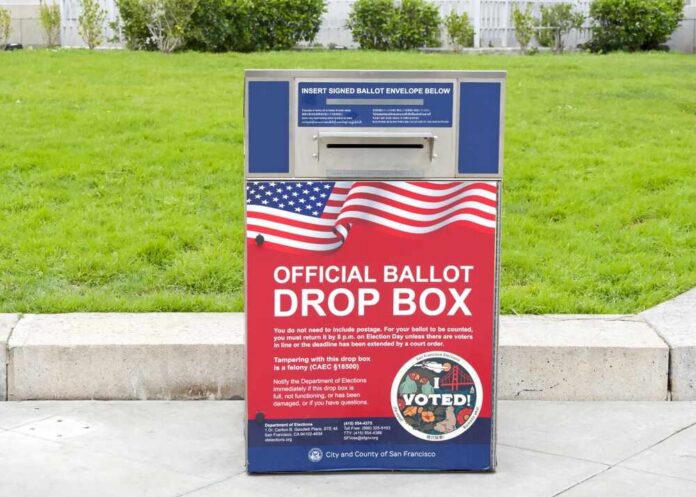
Millions of mail ballots are already landing in mailboxes for the midterms even though the legal fight over who can receive them is still not settled.
Quick Take
- A March 2026 executive order tries to control who gets a mail ballot by building federal voter lists and directing the Postal Service to enforce them.
- The Supreme Court gave the Trump administration a temporary win in August, letting parts of the plan move forward without ruling on whether it is legal.
- Lower courts, including a federal judge in Boston, have repeatedly blocked the order, calling key parts unconstitutional.
- Twenty-three states, the District of Columbia, and several voting-rights groups are suing, arguing the Constitution gives states, not the president, control over elections.
- Ballots are going out now, so any late court ruling could change the rules for voters mid-election.
What The Executive Order Actually Requires
President Trump signed the order in March 2026, directing the Department of Homeland Security (DHS) to build state-by-state lists of adult citizens eligible to vote.
The order also tells the Department of Justice (DOJ) to prioritize prosecuting officials who send ballots to people not on those lists, and it orders the United States Postal Service (USPS) to withhold delivery of ballots to anyone missing from the approved rolls. The stated goal is stopping ineligible people from voting by mail.
Midterm elections have begun in the United States in a fog of confusion over mail-in voting, with ballots already going out as President Donald Trump presses courts to let him impose sweeping new restrictions on how they are handled.https://t.co/8S07JiNtez by @frankietaggart pic.twitter.com/ar0iYJZzMU
— AFP News Agency (@AFP) September 5, 2026
The White House framed the order as protecting “the integrity of the mail” and setting uniform standards for absentee voting nationwide. Supporters argue that federal oversight of eligibility lists closes gaps that states have left open for years.
Critics counter that no evidence in the record shows fraud on a scale that justifies rewriting how tens of millions of Americans vote, a gap that has shaped much of the legal fight.
A Legal Tug-Of-War In The Courts
A coalition of 23 Democratic-led states and the District of Columbia sued almost immediately, arguing the Constitution gives states and Congress, not the president, the power to set election rules.
A federal judge in Boston agreed in June, ruling that Trump had exceeded his authority and declaring key parts of the order “legally void” for violating the separation of powers. An appeals court later upheld that halt, keeping the order frozen through the summer.
The administration kept appealing, and the fight escalated fast. Voting-rights groups, election law experts, and Democratic officials publicly rejected the fraud-prevention rationale, saying federal efforts to override state-run election systems could not survive in court.
National Association for the Advancement of Colored People (NAACP) President Derrick Johnson called the order “unconstitutional” and “unserious”. That kind of pushback kept the case bouncing between district courts, an appeals court, and eventually the Supreme Court.
The Supreme Court’s Temporary Green Light
On August 24, 2026, the Supreme Court lifted the judicial block standing in the administration’s way, letting parts of the plan move forward for now. The order, filed under Trump v. California, did not decide whether the underlying policy is legal.
It simply removed one obstacle while the broader case continues. Two days later, a federal judge lifted the final injunction still standing, clearing more room for implementation ahead of November.
With the midterm elections approaching, the Trump administration on Sunday again asked the Supreme Court to let new restrictions on mail ballots take effect before November. https://t.co/SXJQPqwT86
— ABC News 4 (@ABCNews4) September 6, 2026
That distinction matters. A temporary procedural win is not the same as a final ruling on the merits, and both sides know it. The administration can point to the Supreme Court’s action as momentum.
Opponents can point out, accurately, that the core question of executive authority over elections remains open and headed for more litigation.
Why Critics Call It Unconstitutional
The American Civil Liberties Union (ACLU) and allied groups argue the executive branch simply has no authority to regulate elections, pointing to the Constitution’s Elections Clause, which assigns that power to states and Congress.
They also warn the order is already causing confusion for voters who rely on mail ballots, calling that harm “irreparable” while the case plays out.
Those are serious, specific legal objections, not vague doubts, and multiple judges have found them persuasive enough to issue injunctions.
What Happens Next As Ballots Go Out
Democratic-led states filed yet another lawsuit in late August, signaling the fight will keep running well past Election Day.
Courts have also flagged the Supreme Court’s own “Purcell principle,” which warns judges against changing election rules too close to a vote, adding another layer of uncertainty to any late ruling. Voters, meanwhile, are left mailing in ballots under rules that could still shift before those ballots are counted.
Sources:
cnn.com, thehill.com, supremecourt.gov, brennancenter.org, abc7ny.com, democracydocket.com, npr.org