
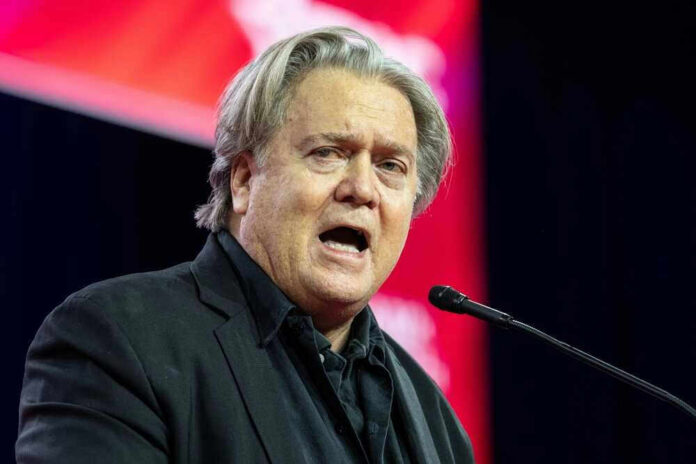
The Justice Department’s extraordinary move to erase Steve Bannon’s contempt conviction after he already served prison time raises serious questions about selective justice and the weaponization of prosecutorial power in America’s increasingly divided political landscape.
Story Snapshot
- DOJ seeks to dismiss Bannon’s 2022 contempt conviction despite having completed a four-month prison sentence
- Solicitor General cites “interests of justice” without specifying new evidence or legal errors
- The move would erase lower-court rulings and set a precedent for executive override of congressional oversight
- Supreme Court paves way for dismissal, effectively mooting Bannon’s pending appeal
- Parallel effort underway for Peter Navarro’s identical contempt conviction
DOJ Reverses Course on High-Profile January 6 Prosecution
The Department of Justice filed a motion in February 2026 seeking to dismiss Steve Bannon’s contempt-of-Congress conviction, a stunning reversal that would wipe clean a case that sent the former Trump adviser to federal prison.
Solicitor General John Sauer informed the U.S. District Court for the District of Columbia that prosecutors determined dismissal serves “the interests of justice,” though the filing provides no explanation of new evidence or legal deficiencies.
Bannon had defied a subpoena from the House Select Committee investigating the January 6 Capitol attack, was convicted in July 2022, and completed a four-month sentence from July to November 2024.
Bannon gets Supreme Court help in erasing contempt charges
The Trump administration said it was seeking to dismiss Bannon’s contempt charges “in the interests of justice.” @CourthouseNews https://t.co/MXsnaq9fs0
— Kelsey Reichmann (@KelseyReichmann) April 6, 2026
Unprecedented Post-Sentence Dismissal Effort
This dismissal attempt stands apart from typical prosecutorial actions because it targets a conviction after the defendant has already served his complete sentence. Judge Carl Nichols, who presided over Bannon’s trial, now faces the decision whether to grant the motion that would effectively erase all appellate rulings upholding the conviction.
The DOJ’s approach bypasses traditional executive clemency routes, instead invoking prosecutorial discretion to nullify judicial outcomes. This maneuver raises fundamental concerns about the balance between executive power and judicial finality, particularly when applied selectively to political allies of the administration in power.
Pattern Emerges with Navarro Case
The Bannon dismissal effort parallels the DOJ’s simultaneous push to vacate Peter Navarro’s contempt conviction for similarly defying the January 6 committee. Both Trump allies claimed executive privilege defenses that multiple courts rejected as legally insufficient under binding precedents like U.S. v. Licavoli.
The synchronized timing suggests a coordinated strategy to undo January 6-related prosecutions initiated under the previous administration. This pattern fuels perceptions across the political spectrum that justice depends less on facts and law than on which party controls the executive branch—a corrosive development for public trust in equal application of the law.
Implications for Congressional Oversight Authority
Legal analysts warn that dismissing these convictions after sentences were served could fundamentally weaken Congress’s constitutional oversight powers. Future administration officials may calculate that defying congressional subpoenas carries minimal risk if a friendly president can simply erase convictions through DOJ discretion.
The contempt of Congress statute carries penalties of 30 days to one year imprisonment and fines up to one hundred thousand dollars, but these deterrents lose force when executive branch prosecutors can selectively nullify enforcement.
This creates a dangerous precedent in which congressional investigative authority becomes subordinate to the executive’s willingness to prosecute, undermining the separation of powers that protects against concentrated government control.
Bipartisan Frustration with Selective Justice
Americans across the political spectrum increasingly recognize that justice appears to depend on political connections rather than equal treatment under the law. Conservatives argue Bannon was politically targeted by a partisan January 6 committee, while liberals see the dismissal as corrupt protection of Trump loyalists.
Both perspectives converge on a troubling reality: the government applies rules differently based on who you know. This selective enforcement corrodes the foundational principle that no one stands above the law.
When prosecutors dismiss convictions for political allies after sentences are served, while ordinary citizens face full consequences for similar defiance, it confirms suspicions that a two-tiered justice system protects elites while punishing regular Americans who lack powerful connections.