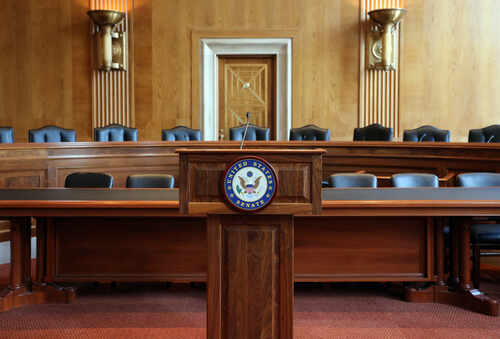
For the first time, the Senate just told a wartime president “stop” — and then admitted it cannot make him.
Story Snapshot
- Senate passed a war powers resolution 50–48 ordering President Trump to end hostilities with Iran[1]
- Four Republicans broke ranks, exposing a real crack in the usual pro-war front[2]
- The measure is symbolic only, with no binding force on the president or the Pentagon[1]
- Fight exposes a deeper, decades-long struggle over who actually decides when America goes to war[17][19]
The first Senate war powers rebuke to a sitting president
The United States Senate did something it had never done before. It approved a war powers resolution aimed directly at blocking U.S. military action against Iran ordered by President Donald Trump[1]. The vote was close, 50 to 48, and it came after nine failed tries to stop the same war[4].
That history matters. Congress did not suddenly discover the Constitution. Lawmakers reached a point where they could not ignore a conflict the administration started on its own and now wants Congress to fund[4][5].
This resolution was built on the War Powers Resolution of 1973, the law passed after Vietnam to keep presidents from dragging the country into war without Congress. That law says the president must inform Congress within 48 hours of sending troops into hostilities and end the use of forces within 60 days unless Congress approves[18].
The Iran measure uses that backbone but goes further. It tells the president to remove U.S. forces from hostilities with Iran unless there is a formal declaration of war or specific authorization[10].
Senate for first time approves a war powers resolution in a rebuke to Trump over Iran conflict https://t.co/FR7wdMVdfr
— WSFA 12 News (@wsfa12news) June 23, 2026
A bipartisan crack in the usual war authority consensus
The vote numbers tell you where the fault lines run. Four Republican senators — Bill Cassidy of Louisiana, Susan Collins of Maine, Lisa Murkowski of Alaska, and Rand Paul of Kentucky — joined most Democrats to pass the resolution[2][3].
One Democrat, Senator John Fetterman of Pennsylvania, voted no[2]. That is not a partisan landslide. It is a narrow coalition of skeptics inside a chamber that usually defers to the president on war, especially when that president is from the same party as its leaders.
Republican leadership and many conservatives argued the Iran operation was limited in scope and needed flexibility. They claimed restricting Trump’s war powers would tie the hands of the military in the middle of a mission[11]. Some went further, saying presidents can run military operations as long as they want, unless Congress cuts off money[7].
From a common-sense view, those arguments have weight. But they clash with the plain text of the War Powers Resolution, which says long-term offensive wars need congressional approval or they must stop[21].
Symbolic power and real limits of a concurrent resolution
Here is the catch that many headlines hide. This war powers measure is a concurrent resolution. That means it does not go to the president for his signature and does not become binding law that courts or commanders must follow[2][4].
News outlets from Scripps to Associated Press described it as “largely symbolic” and “non-binding,” and they are right on the mechanics[1][2]. Trump can ignore it in practice. The Pentagon can continue operations so long as Congress keeps paying the bills.
So why does it matter? Because symbols in Washington often shape the next hard choice. Passing this resolution signals rising concern among Republicans and Democrats over both the war itself and the deal Trump struck with Iran to end it[4][6]. It also sends a clear message to voters: Congress believes this conflict lacks broad support and proper authorization.
The Brennan Center for Justice has tracked how presidents from both parties stretch their claimed authority for foreign interventions without votes in Congress[19]. This Senate move is one of the few times lawmakers have pushed back together, even if only on paper.
Decades of presidents testing the edge of their war powers
This fight over Iran fits a much longer pattern. Since the War Powers Resolution passed over Richard Nixon’s veto in 1973, presidents have tested how far they can go without Congress.
A research project reviewing notifications from Ronald Reagan through Donald Trump shows repeated claims of inherent authority to use forces abroad, even when the mission goes beyond self-defense or protection of Americans[17]. Airstrikes, raids, and limited campaigns have become routine without a war vote.
US Senate has passed a war powers resolution directing President Donald Trump to remove American military forces from the conflict with Iran. pic.twitter.com/h6huMOHhsg
— HadashotIsrael (@HadashotIsrael) June 24, 2026
Legal scholars describe how the executive branch uses tests based on the “nature, scope, and duration” of an operation to justify action without Congress[20]. If the mission is short or narrow, the White House calls it something less than war.
Over time, those definitions stretch. From a conservative standpoint that respects both strong defense and the rule of law, this drift is dangerous. It lets one person’s judgment decide when America fights, while the branch meant to declare war watches from the sidelines.
What this vote really tells us about Congress and future wars
This Senate vote will not stop the Iran war by itself. The administration is asking for about $80 billion more in supplemental funding, mostly tied to the conflict[5]. As long as Congress writes those checks, the war continues, whatever resolutions say.
Some lawmakers talk about audits and oversight, but the pressure to “support the troops” often overwhelms deeper questions about why they are deployed and under what authority. That gap between talk and action is exactly why presidents keep testing limits.
The deeper story is about whether Congress still has the will to use the tools it gave itself in 1973. The War Powers Resolution says lawmakers can force an end to unauthorized hostilities, even through measures like this[3][21]. Yet it took ten attempts to pass a single symbolic rebuke on Iran[4].
Public polling shows many Americans disapprove of Trump’s handling of Iran, but that frustration rarely turns into hard votes to cut off war funding or override a veto[18]. Until that changes, presidents of both parties will keep pushing, and Congress will keep passing statements instead of drawing real lines.
Sources:
[1] Web – Senate for first time approves a war powers resolution in a rebuke to …
[2] Web – Senate passes Iran War Powers resolution despite Trump’s opposition
[3] Web – Senate adopts House-passed Iran resolution in symbolic rebuke of …
[4] YouTube – Senate passes war powers resolution to curb future US …
[5] Web – US Senate for first time approves Iran war powers resolution, in …
[6] Web – House passes resolution to end hostilities with Iran – NPR
[7] YouTube – U.S. Senate passes war powers resolution in rebuke to Trump over …
[10] Web – Senate passes bipartisan resolution to curb Trump’s war authority on …
[11] Web – Senate Approves Legislation To Limit President’s War Powers …
[17] Web – Findings and Analysis | War Powers Resolution Reporting Project
[18] Web – What’s next for the War Powers Resolution on Iran? PolitiFact explains
[19] Web – War Powers | Brennan Center for Justice
[20] Web – War Powers and the Return of Major Power Conflict
[21] Web – [PDF] Ballotbox Diplomacy: The War Powers Resolution and the Use of …