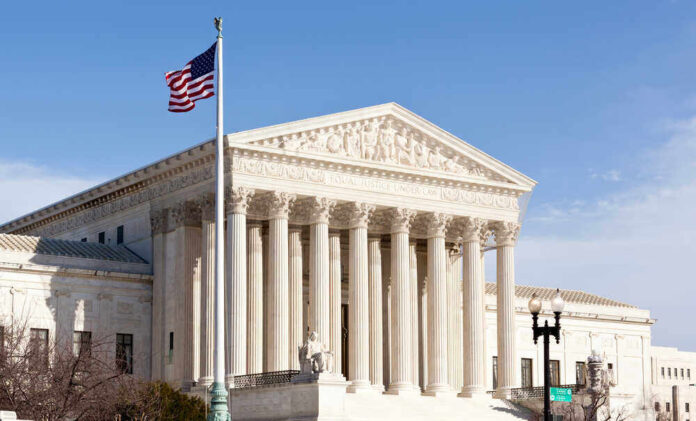
Clearing the way to keep carrying out his agenda, the Supreme Court just handed President Donald Trump a monumental victory.
Specifically, the highest court in the land allowed the administration to proceed with plans for a sweeping overhaul of federal agencies through mass layoffs.
The ruling enables President Trump’s long-promised draining of the Washington swamp, removing bureaucratic roadblocks that have hampered his America First agenda.
The Supreme Court’s decision lifts a lower court order that had blocked an executive order authorizing “reductions in force” across multiple federal departments.
With this obstacle removed, the administration can now begin implementing its plan to restructure 21 federal agencies, including the Departments of Commerce, Health and Human Services, Energy, Treasury, and State.
The court’s brief order indicated that the administration’s actions were likely lawful, although it did not assess specific layoff plans.
The decision was not unanimous as Justice Ketanji Brown Jackson was the lone dissenter.
She criticized what she called the president’s “wrecking ball” approach to government reorganization.
For Americans who have long criticized bloated federal bureaucracy, the ruling represents a significant step toward reducing government overreach.
The decision enables President Trump to fulfill a key campaign promise of streamlining government operations and cutting wasteful spending.
U.S. Attorney General Pam Bondi celebrated the decision with a post on X:
“Today, the Supreme Court stopped lawless lower courts from restricting President Trump’s authority over federal personnel – another Supreme Court victory thanks to @thejusticedept attorneys. Now, federal agencies can become more efficient than ever before.”
While the Supreme Court did not directly address the legality of specific workforce reduction plans, it decisively rejected attempts by activist judges to hamstring presidential authority.
While concurring with the majority, Justice Sonia Sotomayor noted that “The plans themselves are not before this Court, at this stage, and we thus have no occasion to consider whether they can and will be carried out consistent with the constraints of law.”
The battle over the executive order began when California Judge Susan Illston blocked the layoffs, claiming President Trump had exceeded his authority.
In the now overturned ruling, Illston wrote, “As history demonstrates, the president may broadly restructure federal agencies only when authorized by Congress.”
In response, Democrats and government labor unions have condemned the ruling.
The American Federation of Government Employees criticized the decision, insisting that congressional approval should be required for such actions.
A coalition of left-leaning groups, including Democracy Forward, claimed the decision jeopardizes essential government services.
The White House described the ruling as a victory for presidential executive powers.
It affirmed that President Trump has the authority to ensure government agencies operate efficiently and effectively.
The administration has argued that these reforms are necessary to eliminate redundancy, reduce waste, and better serve the American people.
With this legal barrier removed, Americans can expect to see substantial changes in how federal agencies operate.