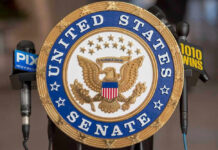
The Supreme Court has been formally petitioned to overturn the landmark Obergefell v. Hodges decision that legalized same-sex marriage nationwide, marking the first explicit request for the Court to reverse this constitutional precedent since 2015.
Story Highlights
- Kim Davis seeks Supreme Court review to overturn Obergefell v. Hodges and gain immunity from $360,000 in damages and legal fees.
- This represents the first direct petition asking the Court to reverse the 2015 same-sex marriage ruling explicitly.
- Davis argues her First Amendment religious exercise rights should shield her from personal liability for denying marriage licenses.
- The Court will consider whether to take the case this fall, with Justice Thomas previously signaling openness to revisiting substantive due process precedents.
Davis Challenges Marriage Ruling After Costly Legal Defeat
Kim Davis, the former Rowan County clerk who became nationally known for refusing to issue marriage licenses to same-sex couples in 2015, has filed a petition for certiorari asking the Supreme Court to review her case and overturn Obergefell v. Hodges.
Davis faces $100,000 in emotional distress damages awarded by a federal jury in 2023 to couple David Ermold and David Moore, plus an additional $260,000 in attorneys’ fees.
Her petition characterizes the Obergefell decision as “egregiously wrong” and argues that her religious exercise under the First Amendment should provide immunity from personal liability.
The case stems from Davis’s refusal to issue marriage licenses after the Supreme Court’s 2015 Obergefell decision required states to license and recognize same-sex marriages.
Davis was held in contempt and briefly jailed for six days in September 2015 for defying a federal court order to resume issuing licenses. Lower courts rejected her qualified immunity and free exercise arguments, holding that she violated established constitutional rights under Obergefell.
Court’s Conservative Majority Creates New Opening
The petition comes at a significant moment for the Supreme Court, which has demonstrated a willingness to overturn major precedents with its 2022 Dobbs decision reversing Roe v. Wade.
Justice Clarence Thomas’s concurrence in Dobbs explicitly invited reconsideration of substantive due process precedents, specifically mentioning Obergefell among cases that should be revisited. This creates a constitutional opening that religious liberty advocates like Liberty Counsel, which represents Davis, hope to exploit.
Constitutional scholars note the Court’s current conservative composition and recent emphasis on historical traditions over substantive due process rights.
However, the Dobbs majority specifically limited its holding to abortion rights and stated its analysis did not threaten other precedents. The Court requires four votes to grant certiorari and five to overturn precedent, making the outcome uncertain even with the conservative majority.
Religious Liberty Versus Established Constitutional Rights
Davis’s petition raises fundamental questions about the balance between religious exercise and constitutional obligations for public officials.
Recent Supreme Court decisions, such as 303 Creative v. Elenis, have recognized First Amendment protections for private businesses that decline services on religious grounds.
However, legal analysts distinguish between private speech rights and government officials’ duty to perform core licensing functions. The petition seeks to extend religious accommodations to shield public officials from personal liability when their duties conflict with their beliefs.
NEW: Supreme Court Asked to Overturn Same-Sex Marriage Ruling https://t.co/dToqCXvyr5
— johnnyA99 (@johnnyA99) August 12, 2025
If the Court grants review and overturns or narrows Obergefell, the implications would extend far beyond Davis’s case. Hundreds of thousands of same-sex marriages could face legal uncertainty, states could diverge on marriage recognition policies, and related benefits involving taxation, healthcare, and estate planning would be disrupted.
Such a decision would also signal the Court’s readiness to revisit other privacy and intimate association precedents based on substantive due process, fundamentally reshaping constitutional protections for individual liberty against government interference.
Sources:
Supreme Court Investigators Fail to Identify Who Leaked Dobbs Opinion – SCOTUSblog
Dobbs v. Jackson Women’s Health Organization – Wikipedia
Post-Dobbs Leak and Supreme Court Ethics Reform – Fordham Democracy Project