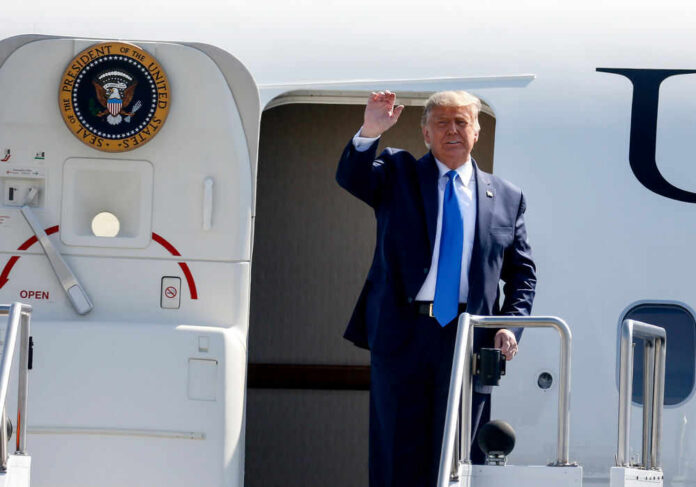
Florida’s push to rename a public airport after President Trump just collided with a private trademark filing that could force taxpayers and officials to navigate a brand-new legal minefield.
Story Snapshot
- DTTM Operations, tied to the Trump Organization, filed U.S. trademark applications on Feb. 13, 2026, for two airport names featuring President Trump.
- The filings landed as Florida lawmakers advanced a proposal to rename Palm Beach International Airport, near Mar-a-Lago, in Trump’s honor.
- Trademark attorney Josh Gerben flagged the move as unprecedented and questioned whether a publicly owned airport would need a license.
- A Trump Organization spokesperson said the filings are defensive, aimed at stopping “bad actors,” and stated no royalties or fees would be sought.
Trademark Filings Land in the Middle of Florida’s Renaming Push
DTTM Operations filed applications with the U.S. Patent and Trademark Office for “President Donald J. Trump International Airport” and “Donald J. Trump International Airport.”
The timing matters because Florida’s GOP-controlled legislature has been moving a bill to rename Palm Beach International Airport, a public facility near President Trump’s Mar-a-Lago estate.
The filings are still pending, meaning federal examiners have not approved or rejected the marks yet.
Because airports are publicly owned and heavily regulated, naming decisions usually flow through government bodies and local authorities rather than private brand managers.
That’s what makes this story different: the renaming debate is happening at the same time a private company connected to the sitting president is seeking trademark protection on the very kind of name lawmakers are discussing. Past presidential airport namings have not typically involved preemptive private trademark claims.
Trump company seeks to trademark his name on airports https://t.co/PEFRXaRYHj
— Daniel Lopez (@4danlopez) February 19, 2026
What a Trademark Could Mean for a Public Airport Name
Trademark law is designed to prevent consumer confusion and protect brand identity in commerce, not to bestow honorary titles on politicians. Still, a trademark can shape what organizations can market, print, or sell under a given name.
Josh Gerben, a trademark attorney who publicized the filings, described the situation as “completely unprecedented” and said it raises the question of whether a publicly owned airport would need to license the name from Trump’s private company.
That question is where practical governance meets cautious constitutional politics. If a local government adopts a name that is trademarked by a private entity, officials may worry about legal exposure when they order signage, build websites, issue press materials, or license concessions that use the name.
The available reporting does not confirm that any airport would actually be billed or sued; it does, however, show that the mere existence of a private trademark application could complicate a public decision.
The Trump Organization’s Defense: Blocking “Bad Actors,” Not Cashing In
Trump Organization spokesperson Kimberly Banza said the filings are meant to prevent misuse of the president’s name, describing the motive as stopping “bad actors.”
Banza also stated the president and his family would not receive any royalty, licensing fee, or financial consideration tied to a renaming.
That direct denial matters because it addresses the core accusation critics quickly raised: that trademarking an airport name ahead of a public renaming could be a pathway to profit.
The publicly available facts in the research do not establish a profit plan or any demand for payment. What they do establish is a familiar modern reality: prominent political figures now operate in a world where branding, licensing, and legal protection of names are standard business tools.
For conservative voters wary of bureaucratic games, the key distinction is whether a defensive filing stays defensive in practice or whether it later becomes leverage over public entities.
Ethics Criticism, Legal Unknowns, and Why This Precedent Matters
Watchdog voices, including the Project on Government Oversight, argue the episode highlights ongoing concerns about blurred lines between public office and private business interests.
The filings also arrive amid broader debate about whether the United States needs stricter conflict-of-interest rules for presidents.
On the other side, supporters point out a basic reality: high-profile names attract impersonators, scammers, and unauthorized merchandising, and trademark filings can be a straightforward way to deter that behavior.
The most concrete uncertainty is procedural: USPTO review is still in early stages, and the Florida renaming bill remains a political question.
If the airport is renamed, local officials and taxpayers could face added administrative work, possible legal vetting, and the optics battle that comes with it.
If it is not renamed, the trademark filings could still serve as a marker of how quickly public honors can become entangled with private intellectual property strategy.
Trump company seeks to trademark his name on airports – ABC News https://t.co/vxQcJSuEaq
— Michael F Ozaki MD (@brontyman) February 19, 2026
For Americans who spent years watching left-wing institutions weaponize rules, language, and corporate pressure campaigns, the lesson is not that honoring a popular president is wrong.
The lesson is that public assets should not become hostages to unclear legal arrangements—especially when the costs and confusion tend to fall on ordinary travelers and taxpayers.
With limited reporting beyond the filings, the real test will be what happens next: approvals, denials, or assurances put in writing and enforceable.
Sources:
Trump Company Files to Trademark Name for Airports as Florida Weighs Renaming
Trump company seeks to trademark his name on airports
Trump’s Private Company Files Trademark for “President Donald J. Trump International Airport”