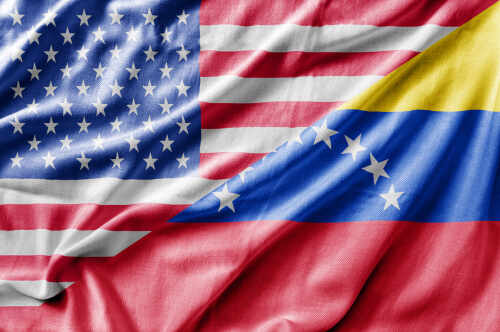
The Trump administration has lifted sanctions on Venezuela’s acting president Delcy Rodríguez, a former Maduro ally previously blacklisted for undermining democracy, signaling a dramatic policy shift that prioritizes oil deals and regional stability over concerns about her authoritarian past.
Story Highlights
- U.S. Treasury removed Delcy Rodríguez from the sanctions list on April 1, 2026, freeing her blocked assets and enabling American business dealings after eight years of restrictions
- The decision follows Trump’s January special forces raid capturing Nicolás Maduro, who now faces drug trafficking charges in New York, while Rodríguez assumes interim leadership
- The Trump administration formally recognized Rodríguez as Venezuela’s sole head of state in March, authorizing the state oil company PDVSA to resume sales to U.S. firms
- The move raises questions about embracing a former regime insider sanctioned for anti-democratic actions, though the administration frames it as a pragmatic step toward economic recovery
Trump Administration Reverses Course on Sanctioned Venezuelan Leader
The U.S. Treasury Department’s Office of Foreign Assets Control delisted Delcy Rodríguez from the Specially Designated Nationals list on April 1, 2026, ending sanctions imposed in 2018.
Rodríguez, who served as Nicolás Maduro’s vice president before assuming interim leadership following his January capture by U.S. special forces, can now access previously frozen assets and conduct transactions with American entities.
Trump officials characterized the decision as support for a constructive bilateral relationship and Venezuela’s economic recovery, despite her history as a key figure in Maduro’s sanctioned regime.
Military Raid Reshapes Venezuelan Political Landscape
The sanctions lift stems directly from President Trump’s January 3, 2026, authorization of a special forces operation in Caracas that captured Maduro and his wife, extraditing both to New York on drug trafficking charges.
Rodríguez, installed through National Assembly action controlled by her brother Jorge Rodríguez, began a 90-day interim term set to expire April 3, 2026, with possible six-month extension.
This unprecedented military intervention replaced years of failed diplomatic pressure and economic sanctions that characterized both Trump’s first term and the Biden administration’s approach to Venezuela’s humanitarian crisis and authoritarian governance.
The US removed sanctions against Venezuelan interim President Delcy Rodriguez, according to the Treasury Department website, less than three months after US forces seized the country's then-President Nicolas Maduro in a raid on the capital https://t.co/v9BhB1mCtT
— Reuters (@Reuters) April 2, 2026
Oil Industry Access Drives Normalization Strategy
Treasury’s March 2026 authorization allowing PDVSA oil sales to U.S. companies preceded the Rodríguez sanctions lift, revealing the administration’s economic priorities. American energy firms gain renewed access to Venezuela’s massive oil reserves while Rodríguez’s government prepares to seize control of Citgo assets from opposition-appointed supervisors.
Trump praised Rodríguez as “doing a great job” and cooperating with Washington, framing the relationship as mutually beneficial despite her previous role undermining democratic institutions alongside Maduro.
The administration initiated embassy reopening procedures in Caracas, signaling full diplomatic normalization despite concerns about legitimizing figures previously deemed threats to regional democracy.
Constitutional and Democratic Concerns Linger
Rodríguez’s rapid transformation from sanctioned authoritarian to U.S.-backed interim leader raises fundamental questions about American foreign policy consistency and commitment to democratic values. She faced sanctions specifically for actions undermining Venezuelan democracy, yet now receives Washington’s endorsement based primarily on cooperation and oil sector access.
Maduro technically retains legal presidential status despite imprisonment, creating ambiguous legitimacy questions. The National Assembly extending her term would consolidate power within the Rodríguez family, as her brother Jorge controls the legislature.
This approach prioritizes immediate economic and energy interests over long-term democratic institution building, a pragmatic calculation that may deliver short-term oil benefits while potentially entrenching familiar authoritarian patterns under new leadership acceptable to American strategic interests.
Sources:
Trump administration lifts sanctions on Delcy Rodriguez, Venezuela’s acting president – CBS News
US lifts sanctions on Venezuela’s acting President Delcy Rodríguez – ABC News
US lifts sanctions on Venezuela’s acting president Delcy Rodriguez – ABC 3340
Venezuela’s Delcy Rodriguez sanctions lifted – Politico