President Trump’s bold executive order to build a national list of verified American voters promises to slam the door on mail-in ballot fraud, but leftist states are rushing to sue over imagined federal overreach.
Story Snapshot
- Trump signs an order directing DHS and SSA to create a nationwide list of confirmed U.S. citizen voters eligible for federal elections.
- USPS ordered to restrict mail-in ballots to verified list only, targeting widespread cheating that Trump calls “legendary.”
- Oregon and Arizona officials threaten to file immediate lawsuits, claiming an unconstitutional intrusion into state election powers.
- The move builds on Trump’s prior actions to secure elections amid ongoing debates over voter ID and citizenship proof.
Order Signing and Core Directives
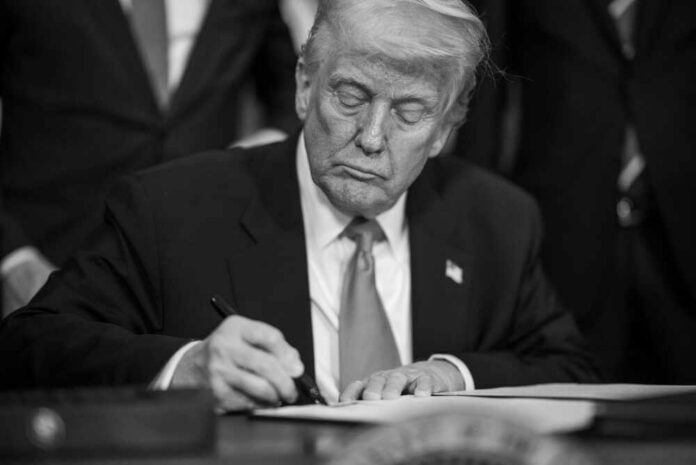
On April 1, 2026, President Donald J. Trump signed an executive order at the White House directing the Department of Homeland Security, in coordination with the Social Security Administration, to compile a nationwide list of verified eligible voters for each state.
This State Citizenship List targets confirmed U.S. citizens aged 18 or older residing in their state ahead of federal elections. The order mandates updates at least 60 days before elections, allowing access for corrections. Trump emphasized this step strengthens election integrity against mail-in vulnerabilities.
Restricting Mail-In Ballots via USPS
The executive order requires the U.S. Postal Service to implement measures preventing ballots from reaching non-eligible individuals, ensuring mail-in voting sends ballots only to those on the verified list. Trump justified the action by highlighting “legendary” cheating in mail-in processes, a concern rooted in post-2020 security debates.
Ballots must include secure envelopes with unique barcodes for tracking. This directly addresses calls for voter ID and citizenship verification, contrasting with states’ current practices of mailing to voter rolls without federal checks.
Trump signs order directing creation of a national voter list, a move sure to face legal challenges | Click on the image to read the full story https://t.co/cAZUWUyRkz
— WBAL-TV 11 Baltimore (@wbaltv11) April 1, 2026
Immediate State Resistance and Lawsuit Threats
Within minutes of the signing, top elections officials in Oregon and Arizona announced plans to sue, citing federal overreach into state authority under Article I, Section 4 of the Constitution. Oregon Secretary of State Tobias Reed criticized the order as politically motivated, vowing legal action to protect all-mail voting systems prevalent in his state.
Arizona officials echoed concerns over interference in state-run elections. These challenges test federalism, with states holding primary control but facing Trump’s push for uniform integrity standards.
Trump anticipates pushback from what he calls “rogue judges,” signaling readiness to defend the order in court. Historical precedents show similar federal efforts blocked, yet this unique mandate leverages DHS and SSA data for centralized verification.
Stakeholder Roles and Broader Implications
DHS and SSA lead list creation using existing records like SAVE for alien verification, with infrastructure due within 90 days. USPS handles ballot restrictions, while the Attorney General prioritizes prosecutions of illegal ballot distribution and potential fund withholding for noncompliant states. Short-term, mail-in heavy states face delays and injunction risks; long-term, successful implementation could enforce stricter checks for 2026 midterms, centralizing data while upholding individual liberty through proven citizenship.
Trump’s action aligns with conservative priorities for limited government fraud, not expansion, by ensuring only eligible Americans vote. Critics fear disenfranchisement for elderly or rural voters, but facts show states maintain core administration. Economic costs hit USPS operations and legal battles, heightening partisan tensions without evidence of widespread prior fraud.