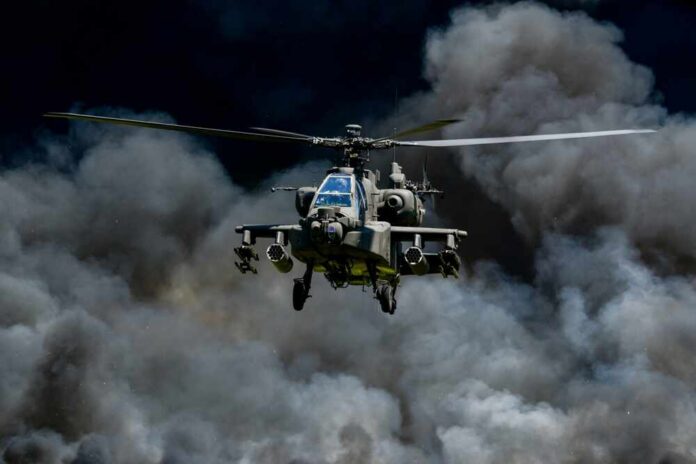
Two Fort Hood soldiers died when their Apache helicopter crashed into a Texas field and set the grass ablaze.
Story Snapshot
- The U.S. Army confirmed two soldiers died in an AH-64 Apache crash near Salado.
- The Bell County Sheriff’s Office received a 911 call shortly after 1:30 p.m. local time.
- The crash sparked a fast-moving grass fire and prompted nearby evacuations.
- Investigators have not released a cause; the probe remains active.
What Happened And When
The helicopter went down in a field near Salado, Texas, early Wednesday afternoon. The Army identified the aircraft as an AH-64 Apache based at Fort Hood and confirmed the deaths of the two soldiers on board. The Bell County Sheriff’s Office said a 911 call reported the crash shortly after 1:30 p.m. local time.
Responders reached the site and found a violent impact scene with no survivors. Officials reported no homes were struck, but the debris field and fire risk forced a wide response.
Two people were killed when a U.S. Army Apache helicopter from Fort Hood crashed in Salado, Texas, on Wednesday, local authorities said. https://t.co/dvVsSE11DW pic.twitter.com/0GpBMFBSKd
— CBS Evening News with Tony Dokoupil (@CBSEveningNews) August 12, 2026
Local fire crews moved quickly to contain a grass fire that spread from the crash. Departments from nearby communities joined the effort. Several homes were temporarily evacuated as a safety step due to heavy smoke and shifting winds.
Roads near the site closed to let engines and tankers work the fire line. Crews reported progress by late afternoon, though hotspots lingered. Officials did not list civilian injuries related to the fire response.
Who Is Investigating And What Comes Next
Army investigators opened a standard aviation accident inquiry. The Army said it would release names of the fallen after families were notified and identification steps were complete. The cause had not been released and could take weeks or months to establish.
Teams will examine wreckage, maintenance records, pilot training logs, and any onboard data. Investigators often reconstruct the flight path from radio calls, radar tracks, and eyewitness accounts to build a timeline.
Local authorities secured the site and coordinated with military teams. The sheriff’s office shared initial timeline points, including the 911 call and staging areas for responders. That record helps cross-check the aircraft’s last known position and the first fire sightings on the ground.
Agencies will also map the burn scar to estimate the fire’s start point and spread pattern. That analysis can link ignition to fuel, hot debris, or electrical sparks from impact.
What We Know, What We Don’t, And Why It Matters
The core facts hold steady. An Apache from Fort Hood crashed near Salado. Two soldiers died. A fire followed and forced evacuations. The unknown is the cause. That gap invites guesses, but guesses help no one. Common sense says wait for the record.
The Army’s safety system usually yields a clear set of findings on weather, crew factors, maintenance, and procedures. That process protects future crews and honors the dead with truth, not noise.
Editor’s note: This is a developing story.
Two people are dead after an Apache helicopter crashed outside of Fort Hood, Texas, according to local authorities.
Emergency calls reporting the crash came in around 1:34 p.m. Central Standard Time, said Cliff Coleman, a… pic.twitter.com/dvGETJ8NO5
— 𝓑𝓸𝓫 𝓢𝓶𝓲𝓽𝓱 (@akita77) August 13, 2026
Claims about blame should rise or fall on facts. If someone points at maintenance culture, training tempo, or parts shortages, that needs hard evidence.
How To Read Early Numbers Without Getting Burned
Early reports often vary on acres burned, exact crash minute, or containment levels. That is normal in fast scenes with smoke, heat, and moving lines. Treat the first numbers as placeholders, not lies.
The better rule is to lock onto the stable pillars: aircraft type, location, confirmed deaths, and which agencies lead. Those rarely change. Let the rest settle as official logs close and investigators release findings. Precision grows with time and review.
Sources:
cbsnews.com, abcnews.com, cnn.com, youtube.com