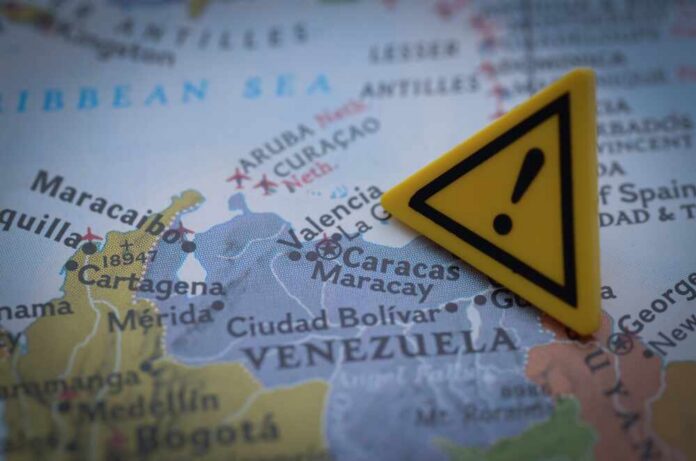
Venezuela’s twin earthquakes turned a few seconds of shaking into a national test of nerves.
Quick Take
- Two strong earthquakes, measured at 7.2 and 7.5, struck Venezuela within seconds of each other.
- Early reports showed real panic in Caracas, with residents running into the streets and some buildings appearing damaged.
- Official damage totals were still incomplete when the first reports hit, which fed confusion and mixed coverage.
- The core dispute is not whether people felt the quakes. It is how much collapse and destruction they caused.
What Happened in Caracas
Back-to-back earthquakes struck near Venezuela’s coast on Wednesday evening and shook Caracas hard enough to send people rushing outside. Reporters described walls falling, dust rising, and furniture visible from the street in some neighborhoods [6].
Eyewitnesses also reported glasses falling inside apartments and neighbors evacuating immediately after the shaking [4]. Those details gave the first news cycle its force. They also created the first question: how much of the damage was visible, and how much was still being guessed at?
The strongest reporting said the quakes measured 7.2 and 7.5, and the U.S. Geological Survey placed their epicenter west of Caracas, with depths that made the shaking sharp and fast [6].
That matters because strong quakes at shallow depth can hit hard in nearby cities. In plain terms, this was not a light tremor. It was the kind of event that can crack weak structures, unsettle older buildings, and scare even people far from the coast.
Why the First Reports Conflicted
The early news picture did not stay tidy for long. Some outlets and on-air reporters said buildings had collapsed, while others said no major collapse reports had reached them yet [8]. The Miami Herald noted that Venezuelan authorities had not yet released a full damage assessment when those first accounts circulated [3].
That gap between eyewitness alarm and official paperwork is where disaster stories often get messy. People on the ground see chaos first. Government confirmation usually arrives later, after rescue teams and local officials compare notes.
BACK-TO-BACK QUAKES: A powerful 7.1-magnitude earthquake followed by a 7.5-magnitude quake shook Venezuela on Wednesday, collapsing buildings in the capital of Caracas and causing injuries. Tsunami alerts and warnings were issued in the area. https://t.co/4pIwxrfWoa pic.twitter.com/iFDsiIlEsR
— ABC7 Eyewitness News (@ABC7) June 25, 2026
That delay does not erase eyewitness accounts, but it does limit certainty. A reporter can see dust, panic, and broken walls without having a complete count of damaged homes.
Officials can also understate or simply lag behind what residents already know. In this case, Acting President Delcy Rodríguez said several states suffered damage, while search teams kept working through debris [6]. That left the public with a half-built picture, and half-built pictures invite arguments.
Why This Story Traveled So Fast
Earthquake stories move quickly because the human details are immediate. A plate drops. A wall cracks. A family runs outside. Those scenes are easy to understand, even on a tiny phone screen. They also travel well in a news environment where dramatic video spreads faster than careful engineering review.
Associated Press footage from Caracas showed that same basic pattern: fear first, confirmation later [4]. That is why the early narrative felt so certain and so unsettled at the same time.
🚨 VENEZUELA WAS HIT BY TWO EARTHQUAKES 39 SECONDS APART. READ THAT AGAIN:
A 7.2 struck northern Venezuela at 6:04 p.m. on a public holiday.
Do you understand what that means?
– Thirty-nine seconds later, a 7.5 hit the same region
– That is not a mainshock and aftershock —… pic.twitter.com/DyBPitkJtH
— 🇺🇸 Edward T. Winslow (@EdwardTWinz) June 25, 2026
The broader setting also shaped public reaction. Venezuela has experienced serious seismic damage before, so people know the country can be hit hard [11][14].
But hazard maps still classify the country’s general earthquake risk as very low, which can make sudden damage feel surprising to outside observers [10]. That tension matters. When a low-risk place gets hit by a major double quake, people ask whether the worst reports are overstated or whether the map never captured the real danger in time.
What the Evidence Supports Right Now
The evidence supports a simple middle ground. The earthquakes were real, strong, and capable of serious damage. Reports from Caracas showed evacuations, collapse claims, and visible signs of structural stress [6][8]. At the same time, the first hours lacked a full official damage tally, and that absence left room for exaggeration and doubt [3].
The most careful reading is that Venezuela faced a severe shaking event with credible local damage reports, but the full scale of collapse was still unfolding when the first headlines landed.
That is the part many readers miss. Disaster coverage often begins with truth, but not complete truth. The first accurate thing may be that people are terrified. The second may be that some buildings failed. The third, and hardest, is the final count.
Until rescue crews, engineers, and officials finish their work, the story stays split between what was seen, what was confirmed, and what was feared. That is where this Venezuela earthquake story still stands.
Sources:
[3] Web – Tens of thousands feared dead and chaos as powerful earthquakes …
[4] Web – Two powerful earthquakes rattle Caracas and central Venezuela
[6] Web – A magnitude 7.1 earthquake struck Venezuela on Wednesday, the …
[8] Web – A major magnitude 7.5 earthquake just struck Venezuela. Damage …
[10] Web – 7.1-magnitude earthquake rattles Venezuela – NBC News
[11] Web – Venezuela earthquakes live blog: At least 32 people killed and 700 …
[14] Web – Two powerful earthquakes, magnitude 7.1 and 7.5, struck west of the …