
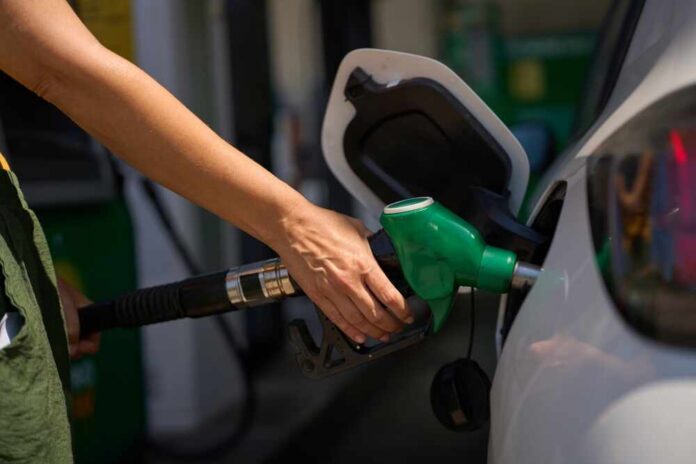
Four-dollar gas is back, and this time it is riding shotgun with a shooting war that most politicians would rather blame than fix.
Story Snapshot
- National average gas price has climbed back to about $4 a gallon, after briefly easing earlier this summer.
- The Iran conflict and Strait of Hormuz turmoil are driving a fresh “war tax” on every fill-up, but they are not the only culprits.
- Refinery problems, tight supplies, and market speculation help turn every missile launch into a bigger bill for American drivers.
- Leaders talk about being “fortunate” or promise prices will drop after the war, while families watch the numbers climb anyway.
Gas Price Pain Returns With The War Headlines
AAA and other trackers now show the national average for regular gas back around $4 a gallon, a line many drivers hoped they had left behind. This is not the first time the war with Iran pushed prices past that mark.
Back in late March, GasBuddy and AAA both reported that the average price had broken $4 for the first time in more than three years, jumping more than a dollar since the first strikes in late February. The pattern is clear: each flare-up in the conflict hits your wallet within weeks.
Newsrooms present the timeline like a simple cause and effect: missiles fly, tankers stop, oil jumps, gas hits $4. Reporters tie the surge to a “war risk premium” placed on every barrel of crude because traders fear supply will be choked off around the Strait of Hormuz.
On paper, it sounds tidy. On the ground, it feels like another case where regular Americans pay first and get the full story later. The attacks are real. The pain is real. The explanation is too neat to accept without questions.
How Iran, The Strait Of Hormuz, And Oil Traders Shape Your Receipt
The Strait of Hormuz is a narrow waterway, but it carries about one-fifth of the world’s oil and gas exports in normal times. When Iran’s war and United States naval moves threaten that flow, tankers slow or stop, and futures markets build in a steep “fear premium” of $5 to $15 per barrel. That shows up fast in pump prices.
Since the war began, several outlets report crude benchmarks like Brent climbing from the low $70s toward triple digits, a jump of roughly 50% or more at the peaks. Gas followed, rising by about $1.10 a gallon nationwide over the span of the conflict.
BREAKING: U.S. gas prices have jumped to an average of $4 a gallon again as the U.S. and Iran launch more attacks. https://t.co/axKon9Fysc
— The Associated Press (@AP) July 20, 2026
Market analysts admit this is not just about barrels in the water; it is about psychology. A Columbia University energy study describes how sudden conflict in that region can trigger initial price spikes into the $175 to $200 per barrel range in worst case scenarios, simply because traders panic and bid up contracts before any actual shortage hits the pumps.
That kind of panic pricing may make sense to hedge funds sitting behind screens. For households living paycheck to paycheck, it looks like another distant crisis turned into an excuse for permanent inflation.
Refinery Outages And Policy Choices Quietly Add Fuel To The Fire
While television shows loop war footage, a quieter part of the story sits stateside. A Reuters report in late April notes that refinery outages in the United States helped push pump prices near a four-year high alongside Iran war disruption. When big refineries go offline, there is less gasoline ready to ship, even if crude is available.
That means any shock overseas lands on a market that is already tight, and the price response is sharper than it has to be. This is where domestic policy matters.
Decades of limits on new refinery capacity, complex environmental rules, and drawn-out permitting leave the system fragile. When something breaks, Washington blames Tehran faster than it admits its own role.
At the same time, regulators try small fixes at the edges. The Environmental Protection Agency temporarily loosens rules on higher-ethanol blends like E15 to increase supply during the crisis, but there is no clear public study showing how much this move actually lowered prices for drivers.
Without hard numbers, those changes look more like public relations than serious relief. A common-sense view would demand transparent impact reports and a plan to harden refinery capacity so overseas gunfire does not translate quite so directly into hometown gas spikes.
Politics, Messaging, And The War-Only Storyline
The easiest script for politicians is to point at Iran and say, “that’s why you are paying more.” Many media outlets repeat that framing, often ignoring other forces such as refinery downtime or seasonal demand shifts. Some leaders go further.
Secretary of State Marco Rubio told Americans they were “very fortunate” even as prices neared $4.50 a gallon, which sounds out of touch when you are choosing between gas and groceries.
President Trump said prices would drop once the Iran war ended, but reports showed that even during ceasefires, pump prices stayed high or kept rising. Promises are cheap; receipts are not.
US gas prices hit an average of $4 a gallon again as the US and Iran launch attacks https://t.co/AqAPtpYBE8
— The San Diego Union-Tribune (@sdut) July 20, 2026
Financial players have their own incentives. Analysts from firms like Societe Generale and high-profile experts such as Patrick De Haan warn of $5 to $7 gas if the Strait stays closed, and those worst-case numbers make headlines. Yet there is no detailed look at whether the people issuing those forecasts stand to profit from volatility in oil futures.
A prudent lens calls for skepticism whenever fear drives markets and the same voices who stoke that fear are paid to trade on it. Americans deserve straight talk: war risk is real, but so are domestic bottlenecks, regulatory choices, and speculative hype.
Unless we confront all of those, four-dollar gas will not be a one-time shock. It will become the new normal every time a crisis erupts overseas.
Sources:
apnews.com, cnbc.com, bostonglobe.com, theguardian.com, time.com, cbsnews.com, aljazeera.com, reuters.com, bushcenter.org