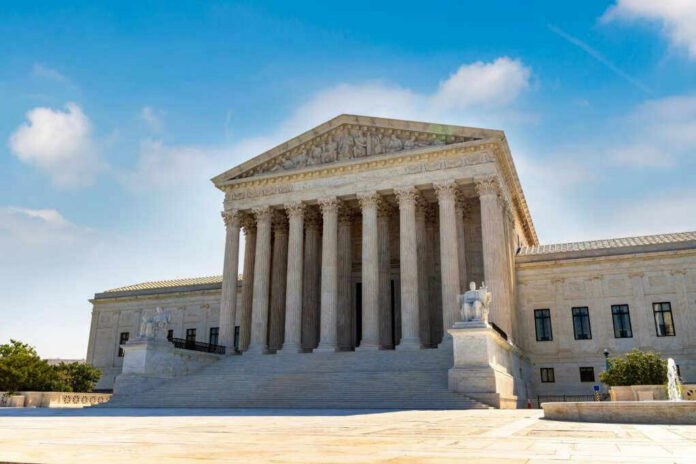
The Supreme Court just handed Alabama Republicans a major electoral victory, overruling lower-court judges who had blocked the state’s congressional map and demanded race-based redistricting ahead of this year’s elections.
Story Snapshot
- The Supreme Court cleared Alabama to use its 2023 congressional map, which includes one majority-Black congressional district, for this year’s elections.
- A federal three-judge panel had previously blocked the map, ruling it intentionally discriminated based on race and ordering a second majority-Black district be drawn.
- The Supreme Court’s emergency order halted the lower court’s block, allowing the legislature’s enacted map to stand while litigation continues.
- Justice Sonia Sotomayor dissented sharply, signaling deep divisions on the Court over voting rights and redistricting law.
Supreme Court Steps In to Restore Alabama’s Enacted Map
The United States Supreme Court ruled Tuesday evening that Alabama may use its 2023 congressional map in this year’s elections, halting a lower-court order that had demanded the state adopt a map containing two majority-Black congressional districts.
The Court’s decision reinstates the Republican-drawn plan, which features one majority-Black district across Alabama’s seven congressional seats. The ruling came as an emergency order, allowing the state to proceed toward the election calendar without redrawing district lines under judicial mandate.
BREAKING — The U.S. Supreme Court allows Alabama to use the new 6R-1D congressional map for the midterm elections.
🔴 +1 GOP
🔵 -1 DEM pic.twitter.com/UZtpM9eeUN— VoteHub (@VoteHub) June 3, 2026
The case represents the latest chapter in years of redistricting battles over Alabama’s congressional boundaries. The Supreme Court’s earlier decision in Allen v. Milligan held that Alabama’s 2021 map likely violated Section 2 of the Voting Rights Act of 1965 by packing too few Black voters into a single district.
Alabama’s legislature responded in 2023 by enacting a new map, which critics argued still fell short of the court’s directive. That 2023 map is now the one the Supreme Court has cleared for use in the upcoming elections.
Lower Court Had Blocked the Map as Intentionally Discriminatory
Before the Supreme Court intervened, a federal three-judge panel blocked Alabama’s 2023 map, finding the Republican-drawn plan intentionally discriminated based on race. The panel stated that Alabama’s legislature “well knew” a map without an additional majority-Black district would dilute Black voters’ opportunity to participate in the political process.
The lower court’s ruling followed extensive litigation, including a full trial record, and ordered the state to adopt a remedial map featuring two largely Black congressional districts instead of one.
Alabama appealed directly to the Supreme Court, asking the justices to halt the lower court’s order while the legal fight continued. The Court granted that request, effectively restoring the legislature’s enacted 2023 map.
These types of emergency redistricting interventions are common when election deadlines approach, forcing courts to decide quickly whether a state’s map or a court-ordered remedial plan will govern an upcoming election cycle. The Supreme Court frequently steps in through interim orders that do not fully resolve the underlying legal merits.
Sotomayor Dissents as Democrats React With Frustration
Justice Sonia Sotomayor dissented from the Court’s order, signaling strong disagreement with the majority’s decision to allow the Republican-drawn map to proceed. Her dissent drew attention from left-leaning media and advocacy groups, who characterized the ruling as enabling racial discrimination in Alabama’s electoral process.
Democrats in Congress expressed frustration over the outcome, with the decision representing another setback for voting-rights advocates who had sought a second majority-Black district through the courts.
Supreme Court allows Alabama GOP-backed congressional map for midterms #politics
— Jonathan Davis (@JonathanDa72879) June 3, 2026
From a conservative standpoint, the Supreme Court’s action reflects a straightforward principle: elected state legislatures, not unelected federal judges, should draw congressional maps. Alabama’s legislature enacted a legal map through the proper democratic process.
Courts ordering states to create districts based on racial composition raise serious constitutional concerns about equal protection and government-mandated racial engineering.
The Supreme Court’s decision to restore Alabama’s enacted map upholds the authority of state lawmakers and pushes back against judicial overreach that would impose race-conscious redistricting on the democratic process.
Sources:
[1] Web – BREAKING: Supreme Court Allows Alabama to Use Congressional Map that …
[2] YouTube – Supreme Court allows Alabama to use congressional map with one …
[3] YouTube – Alabama asks Supreme Court to allow use of congressional map …
[4] YouTube – Supreme Court rules on Alabama congressional map
[5] Web – Supreme Court halts order for Alabama to use US House map with 2 …
[6] YouTube – Supreme Court reinstates Alabama congressional map
[7] Web – What’s Happening with Alabama’s Redistricting Post-Milligan?
[8] YouTube – Supreme Court overturns 2023 ruling on congressional map in …