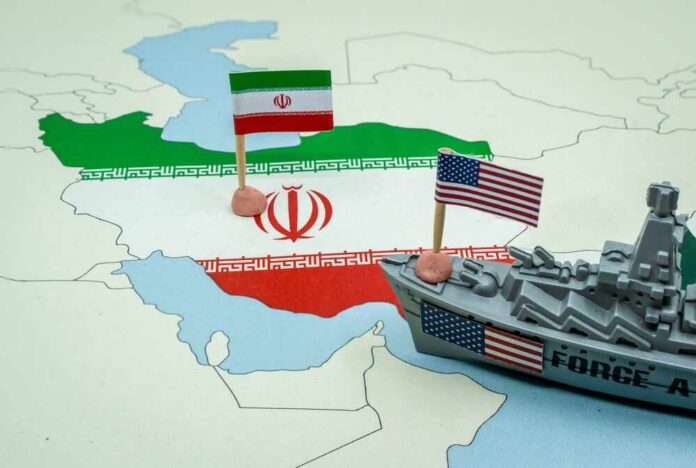
The United States says it saved lives with “self-defense” strikes in Iran, while Tehran says Washington just lit a match next to a powder keg.
Story Snapshot
- U.S. forces intercepted four Iranian attack drones near the Strait of Hormuz, then hit an Iranian ground control site in Bandar Abbas.
- Washington calls the operation a measured defensive response meant to protect troops and shipping and preserve a fragile ceasefire.
- Tehran and its media arm frame the strike as unlawful aggression and answer with their own “retaliatory” messaging and attacks.
- Donald Trump’s “negotiating on fumes” talk adds political pressure and raises questions about where deterrence ends and escalation begins.
Why This “Small” Strike Carries Outsized Risks
U.S. officials describe a tight sequence: four Iranian one-way attack drones launched toward a U.S.-linked commercial vessel near the Strait of Hormuz, intercepted by American forces, followed by a strike on an Iranian drone ground control station in Bandar Abbas that was preparing to launch a fifth drone.[1][5] The Pentagon calls the strike “measured” and “purely defensive,” with the stated goal of protecting U.S. forces and shipping while keeping a broader ceasefire technically intact.[1][5]
Iranian outlets tell a very different story. State-linked media report explosions near Bandar Abbas but insist the impacts were in a barren or uninhabited area, downplaying damage and casualties while casting the episode as reckless U.S. fire into Iranian territory.[3][6] Soon after, Iran’s Islamic Revolutionary Guard Corps claims it has hit a U.S. air base in Kuwait with missiles, branding that attack a “direct reprisal” for Washington’s earlier strike near Bandar Abbas Airport.[3][4] Both sides use the same script: “We defended; they escalated.”
Trump’s “Negotiating On Fumes” Comment And The Pressure Game
Donald Trump has framed Iran as “negotiating on fumes,” signaling that Washington sees Tehran as economically and militarily strained, with few good options left.[4] That kind of language matters because it shapes how both allies and adversaries read U.S. resolve. From a common-sense lens, projecting strength is essential in a region where weakness invites more risk. The danger comes when tough talk collides with hair-trigger military encounters that can drag Americans into a wider war few voters actually want.
NEW: CENTCOM says Iran carried out an “egregious ceasefire violation” overnight, launching a ballistic missile toward Kuwait and multiple attack drones near the Strait of Hormuz.
The missile was intercepted by Kuwaiti forces while the U.S. took out five drones and prevented a… pic.twitter.com/kvqb542Za7
— Fox News (@FoxNews) May 28, 2026
The recent drone shootdowns and follow-on strike land in that gray area between full-scale war and peacetime. American commanders argue that if they allow one-way attack drones to buzz commercial and military targets unchallenged, deterrence collapses and Iran—or its proxies—learns that slow-motion salami slicing works.[1]
Iranian leaders, meanwhile, lean on their own narrative of resistance, saying any strike on Iranian soil demands a response to preserve national honor and regional credibility.[3][4] Each side tells its public it is the restrained adult in the room.
Self-Defense, Ceasefires, And Competing Realities
Central Command insists the operation did not break the ceasefire framework, arguing that limited strikes to stop imminent attacks remain compatible with a broader pause in large-scale hostilities.[1] That is lawyered language, but from a force-protection standpoint it tracks: commanders must stop incoming threats, ceasefire or not. Iran’s messaging flips it.
Tehran’s media ecosystem portrays the same strike as a clear ceasefire violation and as proof that the United States cannot be trusted to honor its own diplomatic lines.[3][6] Ordinary Americans are left watching two incompatible “truths” scroll by on the ticker.
This duel of narratives is not new. In 2019, Iran shot down a high-altitude U.S. surveillance drone over or near the Strait of Hormuz, with Tehran saying it violated its airspace and Washington insisting it flew over international waters.
That episode ended without a larger war, but it established a pattern: intense incidents, disputed facts, and both sides clinging to the self-defense label because international law and domestic politics reward whoever can claim they were simply reacting.[3] The Bandar Abbas drone episode fits that same mold, only now layered onto a live theater-wide conflict.
What This Means For Americans Who Are Tired Of “Forever Tensions”
For Americans over forty who remember the hostage crisis, the tanker wars, and the Iraq slog, the pattern feels familiar. U.S. leaders promise “limited” strikes, say they are tightly focused on missile launchers, drone hubs, or nuclear facilities, and insist there is no appetite for regime change or occupation.[1][6] Iran answers with its own “limited” retaliation and vows that any U.S. presence in the region is illegitimate.[3][4] Each round raises the odds that a miscalculation kills Americans and forces a president’s hand.
The US military executed a precision strike against an Iranian ground control station in Bandar Abbas.
CENTCOM forces intercepted four attack drones before striking the facility as it prepared a fifth launch.
Iranian state media downplayed the hit, claiming they only fired… pic.twitter.com/goSytHSJNj
— The UAE Times (@theuaetimes) May 28, 2026
It all boils down to two questions. First, does this operation clearly protect American lives and vital interests—like keeping the Strait of Hormuz open—without drifting into open-ended nation-building? Second, are we drawing bright red lines that we actually intend to enforce, or offering vague warnings that invite testing?
Shooting down drones that target U.S.-linked ships and striking the launcher makes sense as self-defense.[1][5] The concern is that Washington and Tehran now run that loop so often that one bad day could turn “negotiating on fumes” into fighting over flames.
Sources:
[1] Web – US military conducts another strike against Iran after Trump says Iran …
[3] YouTube – U.S. launches fresh ‘defensive’ strikes against Iran, Tehran hits back
[4] YouTube – US military conducts another strike against Iran
[5] Web – 2025 United States strikes on Iranian nuclear sites – Wikipedia
[6] YouTube – US strikes Iran targets for second time in three days | BBC News