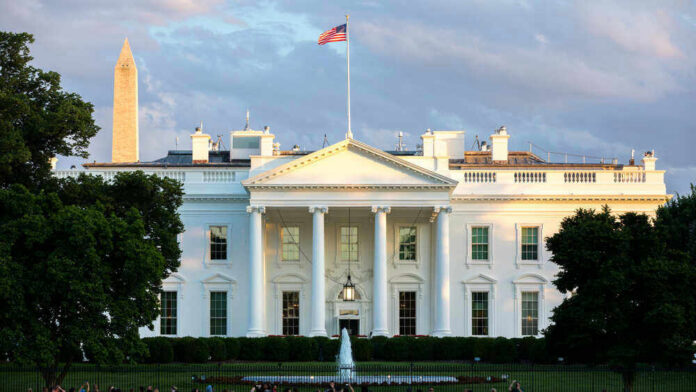
A 21-year-old with a revolver, a history of delusions, and a White House fixation walked back into America’s most guarded perimeter and forced the country to answer a blunt question: what happens when mental illness meets the hard edge of national security?
Story Snapshot
- A young Maryland man opened fire at a White House security checkpoint and died after Secret Service officers shot him.
- A bystander was wounded, highlighting the real human cost of split-second gun battles in public spaces.
- The suspect had prior arrests and bizarre claims about being divine, raising hard questions about missed red flags.
- Media reports lean heavily on official statements, leaving key facts—like motive and bullet origin—unsettled.
The Six O’Clock Gunfire At America’s Front Door
Just after 6 p.m. on a Saturday, near 17th Street and Pennsylvania Avenue, the calm outside the White House broke under the sound of gunfire. According to the United States Secret Service, a man approached a security checkpoint, pulled a weapon from his bag, and began firing at officers stationed there.[1][2] Agents answered those rounds with many of their own. The suspect fell, hit multiple times, as tourists, reporters, and commuters scrambled for cover on streets that usually host selfie sticks, not shell casings.
A man who opened fire Saturday near a White House security checkpoint is dead after being shot by officers who returned fire, the U.S. Secret Service said. It was the third incidence of gunfire in the vicinity of President Donald Trump in the past month. Read more:… pic.twitter.com/d2ATodjST8
— NEWSMAX (@NEWSMAX) May 24, 2026
Reporters on the North Lawn were rushed into the briefing room and told to shelter in place while a temporary lockdown snapped into effect.[4] President Donald Trump was on the White House grounds at the time, but agents moved him to safety and officials later said he was not impacted.[1][2] No Secret Service officer was reported injured, which, given the volume of fire described in early reports, tells you something about both their training and their luck that evening.[1][2]
From Prior Delusions To A Final Confrontation
Authorities identified the shooter as 21-year-old Nasire Best of Maryland.[1][2][3] Court records cited in reporting show this was not his first encounter with the White House security bubble. In July 2025, officers arrested him after he tried to enter another checkpoint, ignored commands to stop, claimed he was Jesus Christ, and said he wanted to be arrested.[1][2] In other incidents he reportedly claimed to be the real Osama bin Laden, the sort of statement that signals a mind untethered from reality, not a normal political grievance.[4]
A judge had previously ordered him to stay away from White House grounds after those earlier run-ins.[4] That order obviously failed to keep him out of danger—his and everyone else’s.
From a common-sense perspective, this is exactly where the mental health system and the criminal-justice system often fail together: a clearly unstable young man, fixated on the most symbolically loaded building in America, cycles through courts and evaluations yet remains free enough to return with a gun. Americans cannot pretend to be surprised when untreated delusion and easy access to weapons produce tragedy.
Split-Second Force, One Dead Suspect, One Wounded Bystander
The immediate exchange was brutal and fast. Witnesses heard a volley of shots, and some outlets described as many as twenty to thirty rounds traded before the scene went quiet.[4] Secret Service personnel returned fire after the suspect opened up on the checkpoint, striking him; he later died at a hospital in Washington.[1][2][3] A bystander was also shot and rushed to medical care in critical condition, though investigators have not said whether that wound came from the suspect’s revolver or the agents’ counterfire.[1][2][4]
That uncertainty matters. When government agents discharge weapons on crowded city streets, citizens deserve precise answers about who hit whom and how. Yet early reporting offers no ballistic mapping, no autopsy detail, and no forensic reconstruction in the public record.[1][2][3] That gap does not prove misconduct, but it does mean the public is still asked to take the agency’s version largely on faith. Responsible skeptics should demand the evidence without rushing to rewrite the story into either a scandal or a whitewash.
Heavy Security, Thin Information, And A Narrative That Hardens Fast
Within minutes, the area locked down under a wall of flashing lights and rifle barrels. The Associated Press described a heavy response that included Secret Service agents, District of Columbia Metropolitan Police officers, and other federal personnel securing intersections and pushing pedestrians back behind cordons.[3] For those on the sidewalks, the message was unmistakable: this was not a minor disturbance; this was treated as an active attack on the nerve center of the executive branch.
White House Checkpoint Shooting: The U.S. Secret Service fatally shot an armed suspect who approached a security checkpoint near the White House and opened fire. One bystander was wounded during the altercation.
— ARX (@ARX_dark_io) May 24, 2026
Yet the story Americans now carry in their heads comes almost entirely from official statements repackaged by local and national outlets. WUSF, News4Jax, and network newscasts all rely on the same core Secret Service description: man approaches checkpoint, pulls weapon, opens fire, agents shoot him, president safe, one bystander hurt.[1][2] That pattern is predictable in national security incidents, but it also means the first draft of history is written mainly by the agency that pulled the trigger—not by independent eyes and ears.[3]
A Harder Look At Accountability And Deterrence
No primary-source evidence in the current record contradicts the government’s specific claim that the suspect fired first.[1][2][3] When someone opens fire at a secure federal site, American instincts properly lean toward backing the officers who move toward the bullets instead of away from them. However, prudence also says that lethal force by the state must always remain explainable in detail, especially when an uninvolved citizen ends up in a hospital bed or on a morgue table.[1][2]
There is a deeper policy failure hiding behind the flashing lights. A mentally ill young man obsessed with the White House came back again, despite prior warnings, court orders, and clear red flags.[1][2][4] That raises uncomfortable questions about how seriously authorities take repeat threats until the shooting starts.
Deterrence at the perimeter appears strong; the agents did their job under fire. Deterrence upstream—in mental health, in courts, in follow-through—is where the system once again looked the other way until gunshots forced it to pay attention.
Sources:
[1] Web – Secret Service fatally shoots suspect outside White House … – WUSF
[2] Web – Suspect dead after opening fire near White House security …
[3] YouTube – Suspect dead after approaching White House checkpoint with weapon
[4] Web – Suspect shot dead after firing near White House. – Los Angeles Times