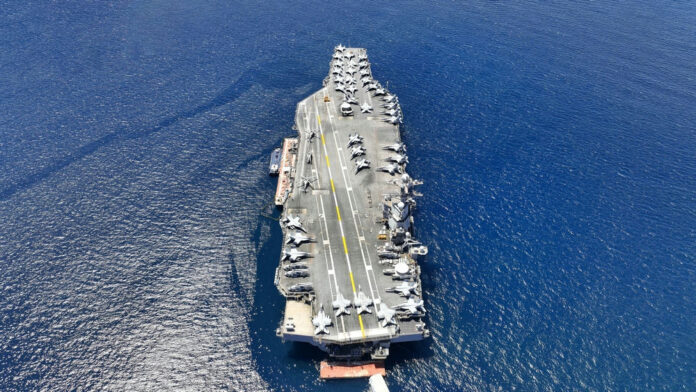
A third US aircraft carrier has pulled into the Middle East, giving President Trump three full strike groups in the region just as Iran flatly refuses to let nuclear inspectors near its damaged sites.
Quick Take
- The USS Theodore Roosevelt entered the US Central Command region on November 15, joining the USS George H.W. Bush and USS George Washington.
- The carrier left San Diego in September with an amphibious group carrying about 2,000 Marines.
- Regional US forces now include more than 20,000 sailors and Marines and hundreds of aircraft, according to reporting.
- Iran says it will not allow United Nations nuclear inspections until the war with the United States formally ends.
Three Carriers Now Sit In The Same Waters
US Central Command confirmed on November 16 that the USS Theodore Roosevelt had crossed into its area of responsibility a day earlier, transiting the Indian Ocean before joining the fight-ready force already there. The command called it part of a scheduled deployment, not an emergency surge. Still, having three carrier strike groups in one region at once is a rare and heavy show of American naval power.
The Roosevelt did not sail alone. It left San Diego in September alongside the USS Makin Island amphibious readiness group, which includes the USS John P. Murtha and USS Anchorage. That group alone carries roughly 2,000 Marines, giving ground commanders options beyond just airstrikes from the carrier’s flight deck.
A Force Big Enough To Matter
Each carrier in the region holds close to 5,000 sailors and dozens of fighter jets, and with three now present, the combined force tops 20,000 sailors and Marines along with hundreds of aircraft. That is not a symbolic patrol. It is the kind of firepower a president assembles when he wants every option, from renewed strikes to a sustained blockade, sitting ready on short notice.
Reporting has tied this buildup directly to President Trump keeping his choices open in the ongoing conflict with Iran. The Associated Press described the carrier’s arrival as a dramatic show of military might timed to a moment when the administration has not ruled out new offensive action. Smaller Navy ships in the area are also reportedly maintaining a blockade on Iranian shipping, adding another layer to the pressure campaign.
Iran Draws A Hard Line On Inspectors
At the same time the Roosevelt arrived, Iran made clear it will not open its damaged nuclear facilities to United Nations inspectors. Tehran’s position is that inspections will not happen until the broader war with the United States is formally over, leaving international monitors locked out of sites that were targeted during the conflict. That refusal lands at the exact moment Washington is flexing its biggest naval muscle in the region in years.
The timing of these two developments, a massive carrier buildup and a flat Iranian refusal on inspections, is not something either side has explained as directly connected. But they are unfolding on the same calendar, and that alone raises the stakes for how each side reads the other’s next move.
Why Carrier Deployments Carry Extra Weight
History backs up why a move like this gets so much attention. Since World War II, the United States has shifted carriers into crisis zones hundreds of times, from the Taiwan Strait standoffs to the Korean War to Iraq’s 1990 invasion of Kuwait, using the ships to deter enemies, reassure allies, and keep military choices open for the president. Research on past military signaling also shows these moves mostly shift the actual balance of power on the ground, not just the politics back home.
That history matters for a conservative reading of this moment. A strong, visible American military presence has long been the clearest way to discourage adversaries from testing Washington’s patience. Three carriers and 2,000 Marines parked off Iran’s coast is not an accident of scheduling alone. It is the kind of hard power that gives President Trump real leverage, whether he ultimately chooses more strikes, a tighter blockade, or a path back to the negotiating table.
What is confirmed right now is straightforward. The Roosevelt is in place, the Marines are in place, and Iran has shut the door on inspectors for now. Everything else, how long this posture holds and what the administration decides to do with it, remains the next chapter still being written.
For now, the message to Tehran is hard to miss. The United States has the ships, the Marines, and the aircraft staged and ready, and it is not moving them anywhere soon.
Sources:
foxnews.com, timesofisrael.com, apnews.com, wiltshiretimes.co.uk, washingtonpost.com, yahoo.com, washingtonexaminer.com, airuniversity.af.edu