A federal judge just drew a hard line around President Trump’s Jan. 6 mass pardon—and left the alleged D.C. pipe bomber standing on the wrong side of it.
Story Snapshot
- Brian Cole Jr. is accused of planting two pipe bombs near party headquarters on January 5, 2021.
- His lawyers say Trump’s sweeping Jan. 6 clemency “unequivocally” shields him from prosecution.
- The Justice Department says Cole was never indicted or convicted by January 20, 2025, so he is outside the pardon.
- A judge has now agreed the proclamation does not cover Cole’s case, despite defense claims it is “inextricably tethered” to Jan. 6 events.
What Brian Cole Jr. Is Accused Of And Why It Matters
Federal agents say Brian Cole Jr., a 30-year-old from Virginia, planted two pipe bombs outside the Republican National Committee and Democratic National Committee headquarters in Washington, D.C., on January 5, 2021.
The devices were found the next day, as crowds were gathering for the Stop the Steal rally that grew into the Capitol breach. Cole now faces charges for interstate transportation of explosives and malicious attempt to use explosives, carrying potential decades in prison if he is convicted.
The bombs did not explode, but they changed the map of January 6. Lawmakers and police had to divert resources to deal with the threat as Congress prepared to certify the election.
From a common-sense view, planting explosive devices near political party buildings is far beyond protest; it is a classic example of the kind of violent act most Americans expect to stay firmly outside any mass pardon, no matter how broad the political rhetoric around “patriots” or “hostages” becomes.
Trump’s Mass Jan. 6 Pardon And Its Built-In Limits
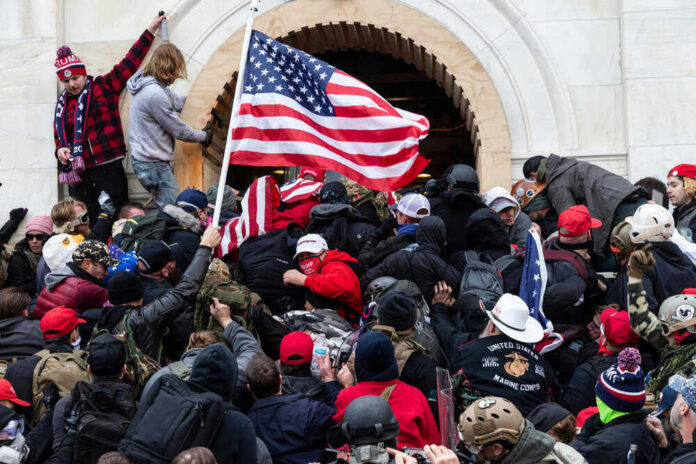
On January 20, 2025, President Trump used his first day of his second term to issue blanket clemency for January 6 defendants. The proclamation granted “full, complete and unconditional” pardons to all other individuals convicted of offenses related to events at or near the United States Capitol on January 6, 2021, and ordered dismissal of pending indictments for that conduct.
About 1,500 to 1,600 people benefited, including high-profile defendants from groups like the Proud Boys and Oath Keepers whose sentences were cut to time served.
Judge says alleged D.C. pipe bomber Brian Cole Jr. isn't covered by Trump's Jan. 6 pardons. https://t.co/VrSEd2qB9G
— CBS News (@CBSNews) July 6, 2026
That scope sounds huge, but it is not infinite. The text, released by the White House, ties relief to offenses related to events “at or near” the Capitol on January 6, 2021. It also directs dismissal of pending indictments for that same date and setting.
The Justice Department later emphasized that, in practice, the pardon applied to people already convicted or already indicted for January 6 related crimes as of January 20, 2025. Cole had not been charged at that time, and his alleged bomb placement happened the day before.
Defense Argument: “Inextricably Tethered” To January 6
Cole’s attorney, Mario Williams, built his strategy on four words in the proclamation: “offenses related to events.” In court filings and interviews, he argues that Cole’s alleged actions on January 5 are “inextricably and demonstrably tethered” to the events at or near the Capitol on January 6.
His position is that you cannot separate the bomb scare at the party headquarters from the broader security crisis around Congress, so the ordinary meaning of “related to” must stretch to cover Cole.
Williams also points out that Trump intended a broad shield for Jan. 6 participants, not a narrow technical fix. He stresses that the proclamation refers to people “convicted” and to pending indictments, suggesting it was meant to reach both those already sentenced and those still on their way through court.
From his perspective, if the bombs were discovered during the Jan. 6 chaos and are part of the same law enforcement narrative, then the president’s order should wipe the slate clean. He has even said his client “100%” deserves the pardon.
Justice Department Response And The Judge’s Ruling
Federal prosecutors answered with a simple line in the sand. They argued that, on January 20, 2025, Cole had not been convicted of any offense and did not have a pending indictment, so he fit neither category that the proclamation explicitly covers.
They also highlighted that the bombs were placed on January 5, and that Cole allegedly told the Federal Bureau of Investigation his actions were not directed at Congress or related to the certification proceedings.
Judge says alleged D.C. pipe bomber Brian Cole Jr. isn't covered by Trump's Jan. 6 pardons. pic.twitter.com/hgSpjRgYxg
— super dlcs (@superdlcs) July 7, 2026
The judge sided with the Justice Department’s reading. In a ruling reported by multiple outlets, the court found that Trump’s pardon proclamation “has no bearing on this case” and is “irrelevant” to Cole’s prosecution. That means the case goes forward, and the pipe bomb charges stand.
From a rule-of-law perspective, this outcome aligns with common sense: a mass pardon for riot offenses should not silently erase a separate, earlier explosive plot against party headquarters, especially for a defendant not yet charged when the pardon was signed.
Why This Fight Over Pardon Scope Should Grab Your Attention
This dispute is not just about one man and two pipe bombs. It shows what happens when presidents issue sweeping, symbolic pardons without clear, fine-grained limits.
History shows there is almost always litigation over what “related conduct” means and whether future, or peripheral, cases sneak under the clemency umbrella. Here, a defense team tried to turn four flexible words into total immunity for a serious, pre-riot bombing allegation—and a judge just said no.
For readers who care about equal justice, this case raises a real question: should political loyalty and clever lawyering turn a broad pardon into a shield for violent acts far outside normal protest?
Many Americans across the spectrum oppose blanket pardons for January 6 already. As this ruling signals, courts can still be a backstop that keeps explosive crimes from hiding behind rhetoric about “events at or near the Capitol,” while leaving room for genuine clemency where the text clearly applies.
Sources:
cbsnews.com, thehill.com, en.wikipedia.org, facebook.com, lawfaremedia.org, nbcnews.com, themarshallproject.org, whitehouse.gov, youtube.com