
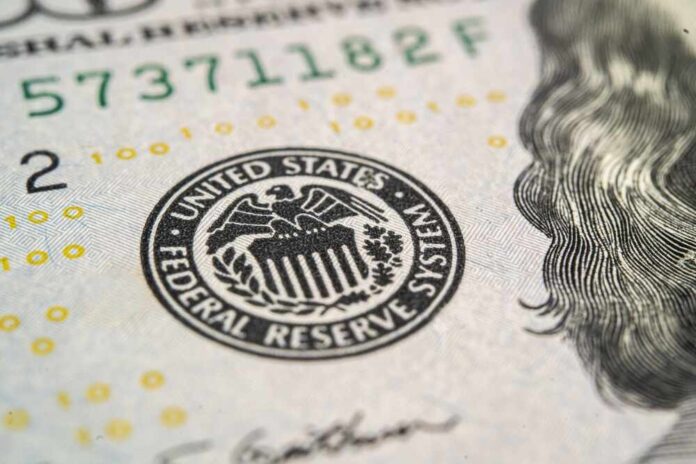
The Federal Reserve’s internal divisions over inflation versus employment priorities signal that interest rate cuts are grinding to a halt, threatening to keep borrowing costs elevated just as President Trump’s pro-growth agenda takes shape.
Story Snapshot
- Fed approves third rate cut of 2025 but signals minimal cuts ahead with only one expected in 2026
- Three dissenting votes reflect deep committee divisions on inflation concerns versus labor market support
- Inflation remains stubbornly at 2.8%, well above the Fed’s 2% target, constraining rate-cutting room
- Trump’s incoming Fed chair nominee faces pressure to prioritize lower rates over traditional inflation-fighting mandates
- Fed resumes Treasury purchases amid market pressures, signaling financial system concerns beneath the surface
Fed’s Hawkish Stance Limits Rate Relief
The Federal Reserve cut its benchmark interest rate by a quarter percentage point on December 10, 2025, bringing rates to a range of 3.5%-3.75%. However, the decision masked serious internal conflict.
Three committee members voted against the cut—the first time such dissent occurred since September 2019—with some favoring even tighter policy. This “hawkish cut” reflects the Fed’s growing concern that inflation remains the primary threat to economic stability.
The committee’s language signaled caution about future reductions. Projections indicate only one rate cut in 2026 and another in 2027, a dramatic slowdown from the three cuts already delivered this year.
This restraint directly impacts borrowing costs for American families and businesses, keeping mortgage rates, auto loans, and credit card rates elevated during a critical period for economic expansion.
Divided Fed approves third rate cut, sees slower pace ahead https://t.co/xWm0ZrwTAi
— CNBC (@CNBC) December 10, 2025
Inflation Refuses to Retreat
The Fed’s hesitation stems from persistent inflation that remains well above target. The central bank’s preferred inflation gauge stood at 2.8% in September, significantly higher than the Fed’s 2% objective.
Committee members expect inflation to stay above target through 2028, reflecting their skepticism that price pressures will ease quickly. This stubbornness justifies the Fed’s cautious approach and explains why rate cuts are becoming increasingly rare rather than routine.
Powell’s Tenure Ends as Trump Reshapes the Fed
Fed Chair Jerome Powell has just three meetings remaining before President Trump’s nominee takes control of the central bank. Trump has signaled his incoming chair must prioritize lower interest rates over traditional Fed mandates of price stability and full employment.
Market predictions favor National Economic Council Director Kevin Hassett, viewed by some as willing to align Fed policy with Trump’s growth-focused agenda rather than maintaining institutional independence.
This transition creates uncertainty about the Fed’s future direction. A chair prioritizing Trump’s rate-cutting preferences over inflation-fighting could undermine the credibility the Fed has rebuilt since the 2008 financial crisis.
Conservative Americans concerned about fiscal responsibility should recognize that abandoning inflation discipline could reignite the price pressures that have burdened working families and eroded savings.
Data Gaps and Market Signals Point to Weakness
The Fed’s decision-making process has been hampered by incomplete economic data from a six-week government shutdown that ended November 12. Despite this information vacuum, recent unofficial data suggests labor market weakness ahead, with announced layoffs through November exceeding 1.1 million.
The Fed’s decision to resume Treasury purchases—buying $40 billion in bills starting Friday—signals underlying concerns about financial system stability that official statements downplay.
These moves represent a critical moment for American economic policy. As Trump takes office with plans to cut taxes, reduce regulation, and unleash energy production, the Fed’s restrictive stance could undermine growth potential.
Conservative policymakers must balance the legitimate inflation concerns that justify caution against the risk that excessive Fed tightness stifles the economic expansion needed to address America’s fiscal challenges.