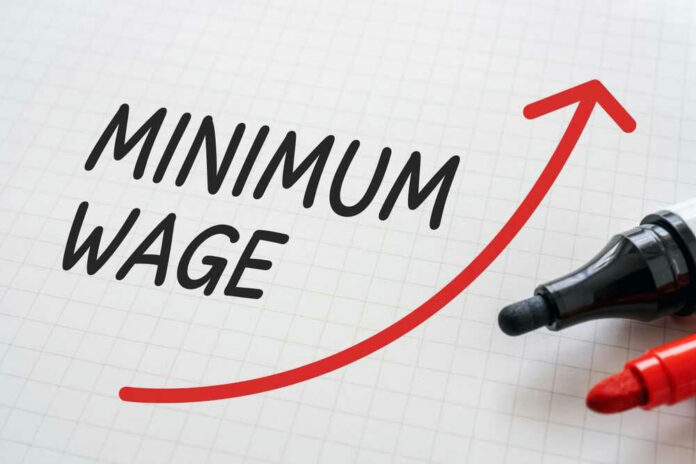
House progressives put a $25 federal wage on the calendar—and the real fight is about what happens to prices and jobs before the clock runs out.
Story Snapshot
- H.R. 8555 sets a path to a $25 federal minimum wage with phased dates and a living-wage target
- Large employers hit $25 first; smaller firms get years longer to adjust under the bill text
- Prior federal scoring of a $15 wage found big gains and real job-loss risks, not both wins
- California’s $20 fast-food case shows price pass-through and disputed job effects
What The Bill Actually Does And When It Bites
House progressives filed the Living Wage For All Act to lift the federal wage floor toward a “living wage” benchmark tied to two-thirds of the national median hourly wage. The bill sets $25 per hour for large employers by January 1, 2031, with smaller employers phasing in to 2038. It scraps subminimum wages for tipped workers, youth workers, and workers with disabilities, and locks in ongoing adjustments so the floor tracks national wage gains over time.
The text gives the strongest economic signal here: lawmakers want the minimum wage to move with the middle of the labor market, not trail it by years. That approach would end the boom-bust politics where Congress freezes the wage for a decade and then scrambles. It also creates a blunt national standard. That helps planning but risks misfitting low-cost rural counties and high-cost coastal cities since the target keys off a national median, not regional living costs.
What We Know From The Best Federal Score We Have
Congressional Budget Office work on a different bill and lower target still matters. The agency found that a $15 federal wage would raise pay for at least 17 million workers and lift about 900,000 people out of poverty. It also projected about 1.4 million fewer jobs once the policy settled in. That paired result—real gains with real tradeoffs—has framed this debate ever since. There is no official score for a $25 national wage with this schedule yet.
Policy detail matters for those numbers. The new bill phases in more slowly for smaller firms and abolishes tipped and other subminimum categories. Those choices shift who pays, when they pay, and how much consumers might see in prices. Without a fresh Congressional Budget Office score on this exact text, claims of a clean win or a costless shock are sales pitches, not settled economics. Lawmakers should request a full distributional and macroeconomic score before floor action.
The Price Channel Everyone Keeps Underestimating
California’s $20 fast-food wage offers a timely sector test. A National Bureau of Economic Research working paper finds restaurants passed higher labor costs to customers and that the price increases lined up with reduced demand and job cuts in that sector. Its estimates imply roughly a 3.9% to 4.1% employment decline if demand scaled with prices. That is not a national $25 result, but it shows where the pressure goes first: the menu board and then the schedule.
Separate teams looking at California reach different job findings. Some Berkeley work reports modest price increases and no significant job decline using its preferred method, while other National Bureau of Economic Research studies show drops in employment, especially among small chains, and slower entry with more exits. Reasonable people can debate methods. Common sense says small, thin-margin operators have less room to absorb fast wage jumps, so their cuts show up sooner.
The Conservative Litmus Test: Who Pays, Who Stays, Who Leaves
Supporters argue that a higher floor boosts work’s value and cuts poverty. The record supports that direction at $15. But national policy must clear a basic test: will families take home more after prices, hours, and taxes, and will their jobs still be there six months later? If the answer varies by region and firm size, then a one-size rule can hit the wrong targets. The bill’s uniform benchmark risks overreach in weaker labor markets while still undershooting in the costliest cities.
Progressives unveil a $25 minimum wage push to solve the affordability crisis despite an economist inflation warning. https://t.co/hkBmEopWzi pic.twitter.com/eqhbtjedNH
— Drew Grimaldi (@Grimillionaire) November 22, 2026
Economist E.J. Antoni’s warning uses a textbook case: set a price floor above the market rate and you get extra supply—people who want to work—and not enough demand—jobs at that price. That is not the last word, but the California evidence gives his point practical teeth on prices and pressure at smaller operators. At a minimum, lawmakers should not pretend the price channel is imaginary. Households notice a higher total at the register the same week a rule changes.
What To Demand Before Congress Votes
Congress should get a full score on this bill’s exact phase-in, firm-size cutoffs, and subminimum wage repeal. It should also test regional exposure with state and county data. The goal is not to bury the idea; it is to match the wage floor to real paychecks and real storefronts. If leaders want a durable living wage, they need a policy that lifts incomes without hollowing out hours or pushing prices up faster than raises for the very workers it aims to help.
Sources:
foxnews.com, govinfo.gov, cbo.gov, ramirez.house.gov, congress.gov, skagittribune.com, yahoo.com, irle.berkeley.edu